

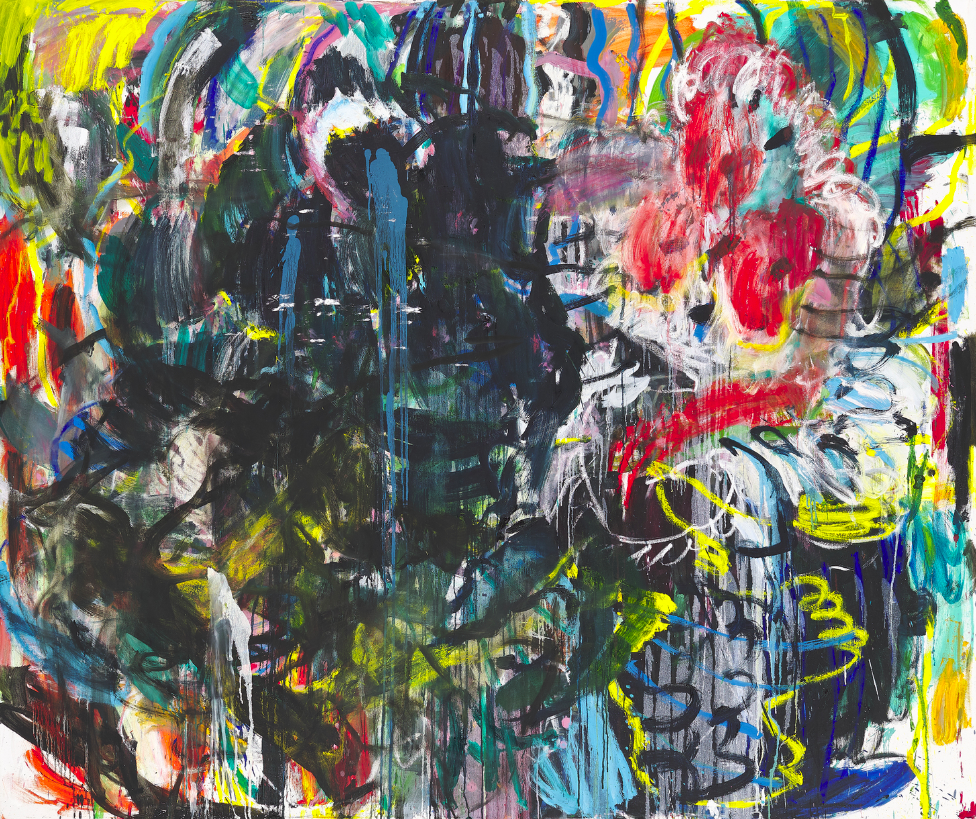
Hata (20 July – 12 October 2019) is Misheck Masamvu’s third solo exhibition with Goodman Gallery, Cape Town. ‘Hata’ refers to a cushion worn on top of the head by women to ease the weight of a carried object.
Masamvu’s work in this exhibit revolves around this idea of ‘hata’, the easing of the burden of history. A text in vinyl letters attached to the gallery wall laments the death of Masamvu’s mother, and the deplorable conditions within Zimbabwe. However, the piece ends on a positive note, claiming that the ‘hata’ can be considered as an act of resistance and adaptation.

Natural Glow is neither the most aggressive piece in Natural Glow (violent pieces such as Pink Gorillas in Hell are Gods, 280 x 550 cm) nor the most reflective. Instead, it balances between these extremes; the point at which the artist notes that a “celebration” and “violent dance” have to occur simultaneously.
In Natural Glow, Masamvu continues to explore the relationship between figurative and abstract forms. The figures, caught between animal and human forms, are both present and absent within the painted layers of oil paint. However, the canvas (205 x 174 cm), although small, allows for a sense of landscape. The brushwork can be viewed from a distance to create a sense of landscape and nature, as well as giving the sense of weather and physicality.
Unlike more explicitly political works in Masamvu’s oeuvre, Natural Glow presents a different palette. Whilst the title suggests natural tones (skin, earth and greenery), it differs from previous works by using fewer alarming reds and greens. Instead, the glow evoked in this piece is subtle and indicates healing of wounds, creating a subtle light that only appears as it fades.
The piece represents post-trauma. The brushwork is layered in a palimpsest-like way. As Masamvu has noted, it represents an emotional dance. In comparison to larger works in this exhibit, the brushwork is more flowing, cyclical and less impactful. The brushwork overlaps, and sometimes works against itself. Similarly, the colour is layered and partially hidden, creating a sense of revision within the artwork. As a result, the painting feels unfinished, and therefore genuine.
Though there is a risk of reducing specific political issues to a generalised idea of African suffering within Masamvu’s work, the theme of this exhibition (and specifically Natural Glow) subverts this.
Natural Glow does not represent the political or physical landscape of Zimbabwe. Rather, it represents the psychological impact experienced by an individual. As the son of a late mother, as an artist trained in Munich before returning to a country in decline, and as a figure within a culture informed by German expressionism, and Shona beliefs (where boundaries within human and animal are blurred), the painting captures a complex identity.
Therefore, the title of this piece makes sense. ‘Natural Glow’ does not refer to a peaceful idealised natural environment, but to natural light produced from within the body having processed its trauma. This light originates from the artist himself, being processed by the individual. Although arguably the painting is weaker in the middle, the scale of the piece (205x174cm), in combination with a relatively muted palette, means that the viewer may feel uncertain as to what the intended focus of the piece is. Within the layered brushwork, there seems to be no clear point of reference.
Although this is deliberate (Masamvu has noted that he wishes for viewers to “reconstruct meaning” in the piece, and not be provided with a clear message), the composition may seem lacking in commitment. The painting puts a lot onto the viewer, and so the amount of ambiguity within it will be interpreted differently depending on whether it is seen as generous or shying away from clear messages.

Comments are closed.