

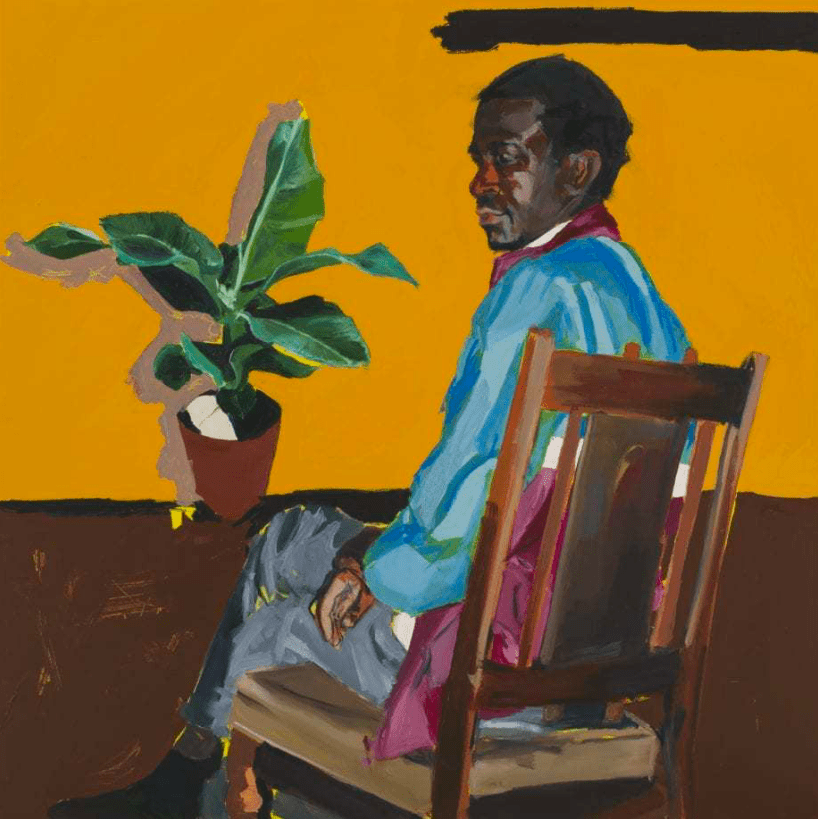
Within an abstract and intensely saturated colour field, an image of an elderly man is depicted. This painting measures 60cm x 60cm and was painted using acrylic and oil.
While the title suggests this is a representation of a specific individual within the artist’s family (Sekuru means “Grandfather Koni” in Shona), the painting itself does not simply depict this person, but rather acts as an invocation. The absence of the deceased is felt as intense colour.

As this painting was created through collaging digitally before being transferred onto the canvas, the image of the elderly man appears slightly suspended. The soft edges of the figure suggest it has been sourced from photographic imagery, and inserted onto a surface which is only semi realistic. However, despite the softness, the image still contains the pixelation of the digital format, but as it has been painted in oil, a material sense is also present.
This tension between the digital and physical is key to this piece. As Hwami has spoken of growing up in her pre-teen years in ‘cyberspace’ (Tumblr), searching for images of Black people which felt representative of her in order to ‘see herself’, this search forms part of her process. Whilst this piece can be seen as a family portrait, it is also a composite of many people. As well as representing one specific individual, it represents a generalisation. In addition to representing memory, the image can also be seen as fictional.
The colours used in this piece convey meaning. The reds used do not draw upon traditional African patterns, or national flags, but instead reference 2AM screen lighting, notifications and red faces caused by embarrassment or heat.
The blues reference both the sea, and the blue light commonly found on mobile phones. By combining these two references, Hwami creates an equality between the past and present. In this piece, neither the grandfather nor the audience can be defined as ‘traditional’ or ‘modern’ as both are immersed in the same pool of colour.
Whilst this piece is not explicitly Afrofuturist (through technological advancement or fictional narratives), it is a subtle example of Afrofuturist thought. It suggests that even in the present, the future exists.

Comments are closed.