

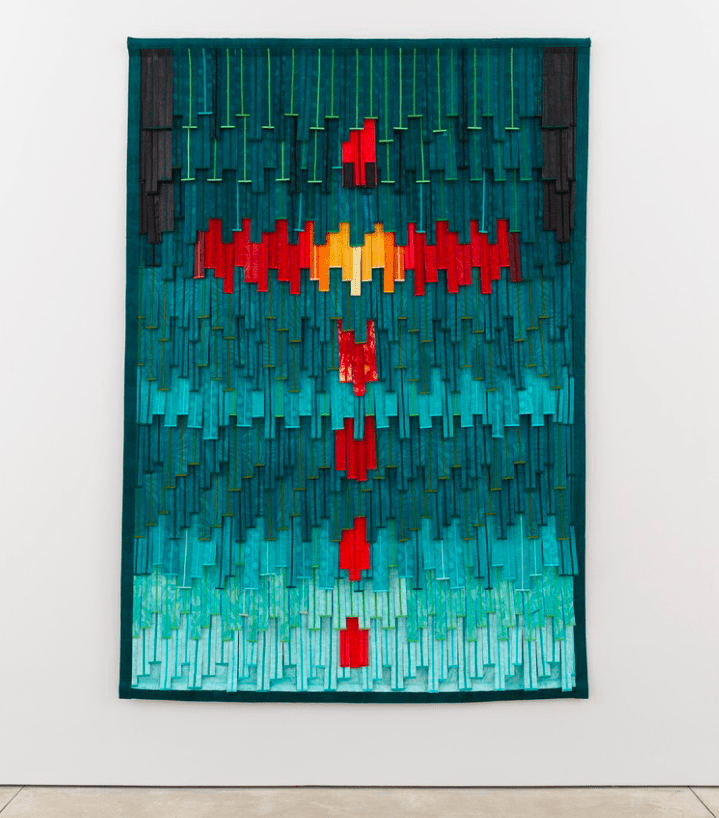
Abdoulaye Konaté’s La Croix (2019) creates an immersive experience of light. The large scale piece (268 x 187cm) is made up of hundreds of dyed cotton strips. Through folding, sewing and layering, the piece has an intense vibrational energy.
La Croix was included in Konaté’s first solo exhibition in the USA at Blain | Southern (Chelsea 3 rd May 2019 – 15 th June 2019). Within this body of work, it is the most concise expression of his practice, considering his body of work over 3 decades has varied between figuration and pure colour.
La Croix is significant in understanding Konaté’s artistic journey as it represents a culmination of Konaté’s move towards abstraction. Born in Diré in 1953, Konaté now works out of Bamako. He originally worked in oil and acrylic, however, due to material limitations within Malian artistic production, such as lack of paint availability, and widespread woven cotton production within the area, Konaté turned to using cotton in his work.

By the late 1990s, Konaté was producing large works by sewing. By 2019, his work has moved largely from figuration to pure colour and geometric form (such as in La Croix and Vert Touareg au 3 cercles ). In this piece, only form and colour are present.
Although the shape of the piece appears to be a cross (as in western Christianity), it is better understood as a source of energy. Energy emanates from a central axis. The colours progress from a warm red/orange/gold at the centre to cool tones around the edge of the piece. This creates a temperature map within the work, with high temperatures at the centre and fading at the edges. Konaté has described colour as “light effects” and “an effect of light,” The piece utilises this idea in a very controlled, colour field style. Although the material used is cotton, rather than acrylic paint, the strips take the place of brush strokes, creating a dense intensity of light.
This piece embodies a contradiction. The work is made from materials directly tied to Malian culture. The cotton used is from local sources and the dyed strips utilise traditional methods. The striping in this piece also relates to the dress of the Senufo people, and wider patterned clothing worn in West Africa.
However, the composition of the piece is intentionally universal. It could be displayed with artists such as Mark Rothko and František Kupka and still be comparable. The work raises questions as to whether this universality is a true unification of cultures, or simply a simplification of cultural specific knowledge.
As the strips have become pure gestures of colour, the information inherent in the textile has been lost. We lose information about the individual who dyed these strips, and therefore the culture within which they were made, as well as information about the economic factors surrounding the cotton in Mali, as it is a main export.
Within this exhibition (Couleurs d’âme ), the gallery explains how this work takes “takes specific local ideas into a realm that is more universal and spiritual.” In this reading, the cross is representative of internationalism. Whilst the composition is universal, it is physically tied to one culture.
In 2019, Konaté was also chosen to exhibit at the 13 th Havana Biennial. As such, refusing to be interpreted as ‘African art’, in a narrow ethnographic sense, is a political statement. Konaté is asserting that his work, a textile piece created by a Malian artist, should be viewed as equally valid as any abstract western artworks.
The composition of this piece is very well constructed. The repetitive strips, precise folds, and small tonal changes in the bands of colour show that although Konaté has designed the piece, and the colour, a team of up to 30 people have sewn the piece. The piece therefore appears beautiful both from far away and up close. From far away, the intense colours create a vivid and almost hallucinogenic appearance. However, looking closely at the piece the intricate construction of the threads and dyes becomes apparent.
The ‘ruffled’ edges give the piece a sculptural quality, making it appear to hang. This reminds the viewer that the piece is a textile, rather than paint. The physicality of the piece gives it weight and texture, which cannot be replicated by paint.
This piece is limited in that the political and spiritual implications of the piece are strongly implied, rather than stated explicitly. The political and spiritual meaning of the piece is present, however it is difficult to perceive unless we understand the context. By comparison, Konaté’s earlier works, such as L’intolérance (1998), which include found objects, text and an outstretched body, convey their meaning more explicitly.
Therefore, in this piece, the viewer must feel the meaning, rather than read it. Whether this is considered to be positive or a compromise depends on personal preference. If a critic prioritises material specificity of the textile traditions of West Africa, then perhaps this piece is problematic in becoming too homogenous in aesthetic. If, however, a critic prioritises a pure aesthetic, then this piece demonstrates exceptional composition of colour.


Comments are closed.