

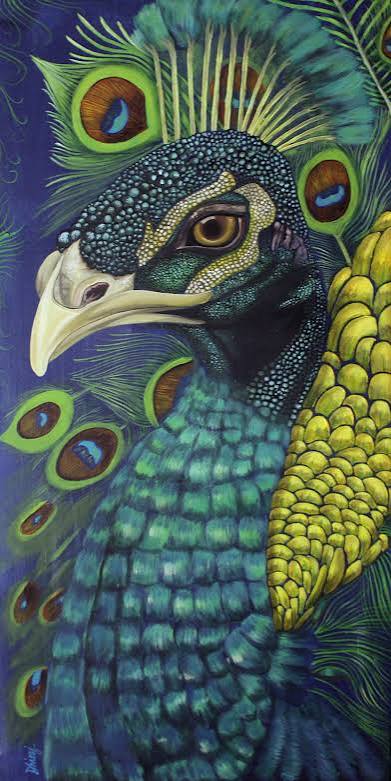
Dhiraj, a South African artist and founder of Artist 27, drawsa peacock in this untitled painting. The bird is shown in close view, with its head, neck, and body taking up most of the picture. Its feathers extend across the background, forming different shapes and patterns.
The use of blue and green are the dominant colours on the peacock’s body. The head and neck contain several shades of blue, green, and turquoise, while yellow appears across parts of the feathers. Purple is used in the background, creating a difference between the bird and its surroundings. The use of these colours reflects the natural appearance of a peacock.
The bird’s face is carefully painted, with attention given to its eye, beak, and head. Its head faces the left side of the picture, while its neck curves downwards into the body. The small markings around the head and the changes in colour across the neck show the artist’s attention to detail.
The feathers contain repeated eye-shaped patterns in shades of blue, green, and brown. These patterns vary in size and arrangement. The feathers overlap and extend in different directions, creating repetition across the composition. The yellow sections on the right side differ from the blue and green areas of the bird.
The background consists of large feathers with similar eye-shaped markings. They spread around the peacock and occupy most of the available space. The dark purple areas separate the individual feather patterns and contrast with the brighter colours.
The artist also uses detailed brushwork to represent the texture of the feathers. Small markings cover the head, while layered strokes define the neck and body. The overlapping feathers create depth and distinguish the different parts of the bird.
The painting places the peacock at the centre of attention. Its head occupies the upper section, while its body extends towards the lower part of the picture. The surrounding feathers fill the remaining space, connecting the bird to the background.
The painting focuses on the physical features of the peacock through detailed representation, repeated patterns, colour, and texture.


Comments are closed.