

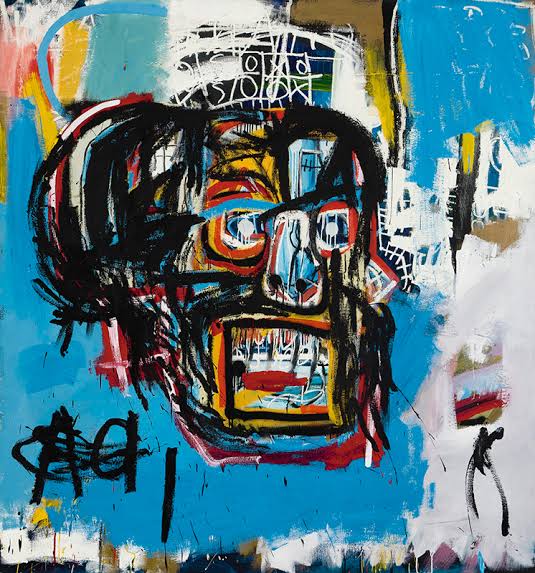
Basquiat’s Untitled (1982) turns the human face into a battleground of paint. It belongs to Neo-Expressionism, where raw marks, simplified forms and gesture take priority over polish or realism. A mask-like head fills the canvas, built from jagged shapes and thick black outlines. The eyes are oversized and mismatched, their white interiors glaring out from rings of red and yellow. The nose is broad and blunt, and the mouth gapes across the lower face, its rows of teeth picked out in white, black and yellow. Nothing follows realistic proportion. The features crowd and stack against each other, so the head reads as a charged assembly of parts rather than a portrait of a person.
Colour drives the energy. Bright blue floods the background while red, yellow, white and black break across it, the warm tones cutting into the cool field. Black does the structural work, fixing the features and separating the overlapping forms. The palette feels loud and restless, never settled.
Basquiat paints fast and loose. Some strokes are thick and forceful, others thin, scratched or barely sketched, and he leaves every mark exposed so the process becomes part of the picture. Heavily worked passages sit beside open patches of colour, and the layers suggest an image built through constant addition and revision. Handwritten marks, symbols and abstract lines run across the upper section and along the lower edges, blurring the line between painting and drawing and showing writing used as a visual element in its own right. Scattered marks spill beyond the face, and the uneven placement of blue, white and black keeps the composition asymmetrical. The face still anchors the eye, but the activity around it gives it its structure.
Through distortion, colour, text and gesture, Basquiat rejects traditional portraiture. The exaggerated features, exposed teeth, ragged outlines and layered ground give the work its force, and the face becomes a vehicle for exploring the physical act of painting itself.