

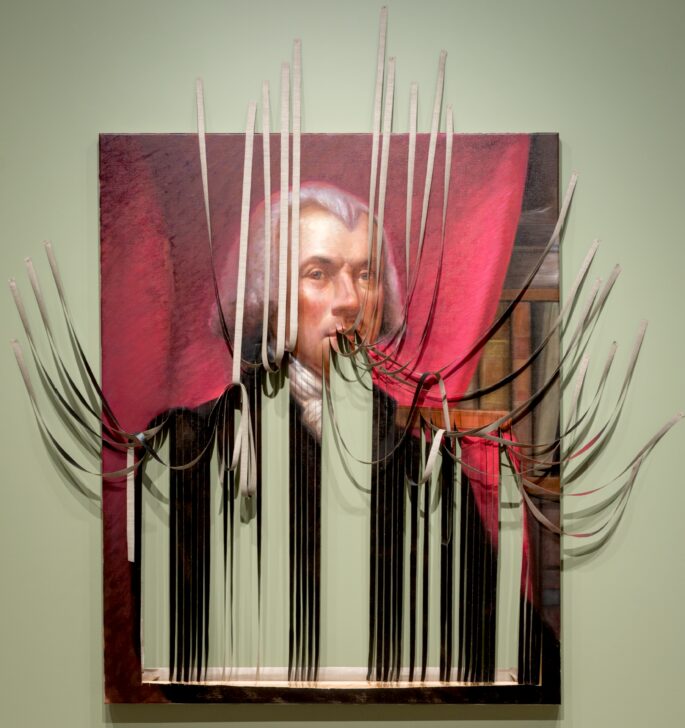
A historical portrait takes a different form in Titus Kaphar’s Flay (James Madison) (2019). The work combines a painted image with long strips of material that hang across the portrait. James Madison, the fourth president of the United States, appears in the centre, dressed in dark clothing against a deep red background. The hanging strips interrupt his image, covering parts of his face and body. This arrangement changes the way the historical figure is seen and shifts attention from the portrait to the materials placed over it.
Madison’s face remains partly visible through the hanging strips. His grey hair, pale skin and facial expression retain the appearance of a traditional historical portrait. The dark clothing forms a contrast with his face, while the red background adds another layer of colour. Some of the strips cross directly over his facial features, making it difficult to view the portrait as a complete image. The figure appears caught between visibility and concealment.
The strips extend beyond the frame, with some reaching towards the floor and others bending outwards. Their different lengths and directions make the arrangement uneven. White, grey and black surfaces appear along the strips, creating further contrast against the red background. Their shadows also fall across the painting, adding depth and making the materials appear separate from the painted surface.
The wooden frame and rectangular painting provide a fixed structure for the work. However, the hanging materials interrupt this shape and extend the composition into the surrounding space. The contrast between the flat portrait and the projecting strips gives the work both painting and sculptural qualities. The viewer is not only looking at an image but also observing how physical materials cover and divide it.
Madison’s identity gives the artwork its historical meaning. Although remembered as an important American political figure, he was also a slaveholder. Kaphar draws attention to this part of his history, which is often separated from traditional representations of political leaders. The strips covering the portrait suggest the parts of history that have been hidden, ignored or left out of public memory.
The use of concealment is closely linked to the title, Flay. The strips appear to pull apart the image, exposing and hiding different sections of the figure. This treatment changes the polished appearance associated with historical portraits. Instead of allowing Madison’s image to remain untouched, Kaphar interrupts it with materials that make the viewer question what the portrait represents.
Through the combination of portraiture, hanging materials and historical reference, Kaphar examines the relationship between power and public memory. The work questions the way historical figures are remembered when important parts of their lives receive little attention. Flay (James Madison) makes the viewer look beyond the familiar image of a former president and consider the history concealed behind it.


Comments are closed.