

Flamenco Dancers (2011-12) captures the culmination of El-Salahi’s artistic fusion of Arabic calligraphy, Sudanese art and Western modernism. This large scale piece spans 203.6cm by 243cm (six panels), and feels more like a performance.
El-Salahi created this piece using his well known ‘nucleus’ technique, whereby a central white arc (a direct reference to the horseshoe arch found in the Alhambra) is surrounded by a background of burnt sienna, umber and ochre. This evokes a sense of sunburnt plaster. The dancers, rendered in black, seem to stretch and intertwine, creating a feeling reminiscent of the spirit-duende within flamenco singing, as well as the intricate geometric patterns in Islamic arabesque. As such, the figures are at once dynamic human forms, calligraphic lines, natural and decorated, Andalusian and Sudanese.
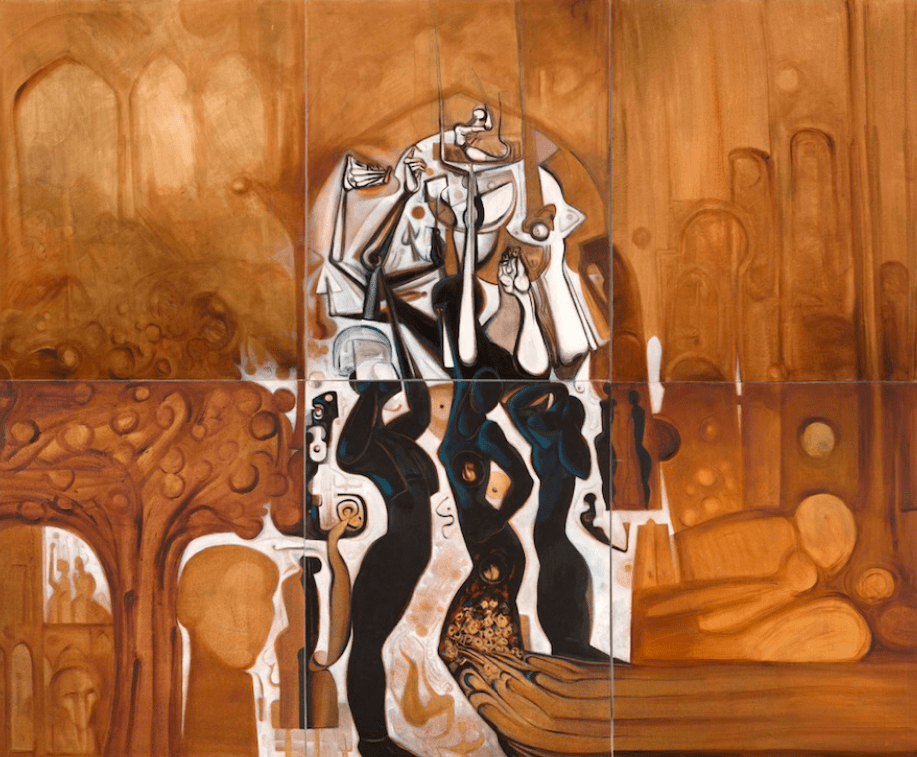
Unlike many other skillfully fused pieces from this time, Flamenco Dancers demonstrates structural integrity. The architecture and movement within the piece are one in the same. The abstract representation of limbs, pedestals and castanets has evolved directly from the brown tones of the background. As such, there is no element of artificiality. El-Salahi has described how he often allows his artworks to naturally develop from one central point, until reaching their ‘complete’ form.
The limited black, white and terracotta palette ensures that the image does not devolve into illustrative folk art. However, this colour scheme adds to the dynamism of the piece. As the black figures become more contorted and arched, the limited colour scheme makes the movement within the piece seem very controlled, yet forceful. While Matisse similarly uses cut-out forms, his vivid colours create a sensation of liberation. Here, however, the limitation of monochrome forces movement into a very tight space.
If there is any issue with this piece, it resides in the outer sides. While the central arch and cluster of dancers are very strong, the calligraphic abstraction in the side panels falls back on more purely decorative patterns. Although there is rhythmic consistency in these side panels, in some places they seem like an unnecessary addition. Nonetheless, this piece is special in being able to make a six metre long painting feel as if it is a continuous breath.
While fitting into a similar discussion as El-Salahi’s Alphabet series from the 1960s, this piece is very different due to it being performative. With El-Salahi now 82 years old, he no longer explains his visual language, but lets it flow. In the Sharjah Art Museum collection, this piece provides the clearest example of what African and Arab Modernism can look like when it is not apologetic or explanatory, but simply vibrant.