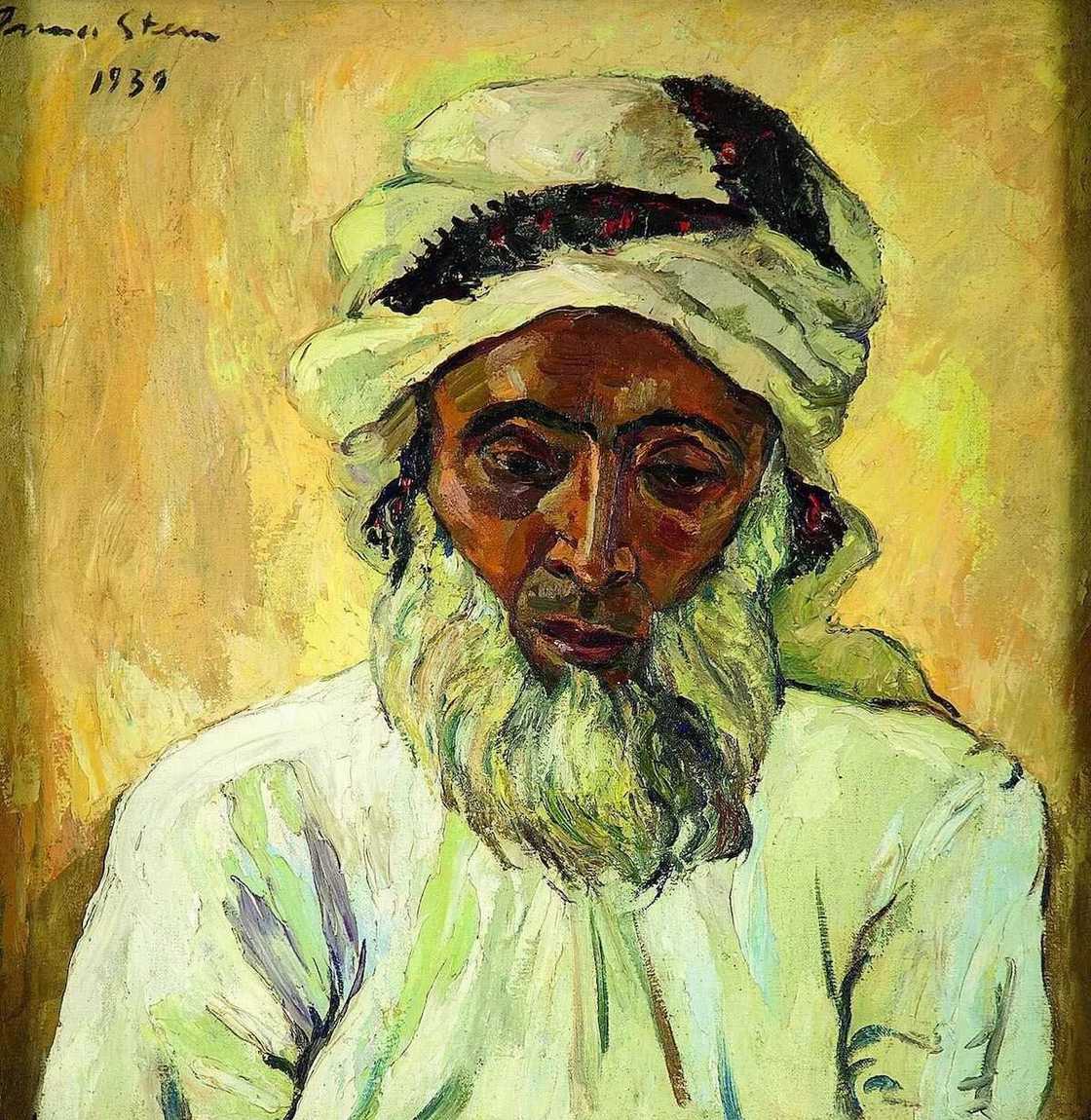
Irma Stern’s Arab (1939) encapsulates the artistic peak of Irma Stern’s time in Zanzibar better than any other work.
This painting was produced during Irma Stern’s initial four month stay in Zanzibar. It depicts an aged Omani Arab man. He has white facial hair, wears white robes and a turban with a single red/black stripe. He appears to be looking down.

After being labelled as a “worshipper of ugliness” in South Africa, Irma Stern discovered a new subject matter in Zanzibar. She was able to move away from the shallow depictions of ‘native’ people, and create images with “depths of suffering, profound wisdom and full understanding of all the pleasures of life.”
In this piece, Irma Stern removes any background information about the subject. Only the upper half of the figure is visible, however the background is solid and bright yellow. This yellow does not provide background information or create a halo effect, instead is used as a flat area of intense colour.
With both the cropped composition and the almost monochrome palette (the white robe, beard, turban, yellow background and single dark ribbon), Irma Stern captures what she considers to be the essence of a person.
There is no narrative within this work. Instead, the work is very internal. The paint textures have been used to create texture on the skin and fabrics.
Impasto techniques have been used to great effect in this painting. Irma Stern has applied her signature blue underpainting (a common technique within German Expressionism, in contrast to the warm sienna backgrounds within academically trained art) and painted thick strokes of paint in deliberate directions. As stated in the Norval Foundation’s exhibition text, “these strokes echo the calligraphic motifs in the Zanzibari carved cartouches [door lintels], and Islamic manuscripts collected by Stern.”
The texture of the paint has been used structurally. Within the white robe, ridges have been created using paint to create physical highlights. As a result, the image has a sculptural quality, and appears to be protruding from the background. Conversely, the face of the figure has a looser texture. The facial features have not been clearly defined, creating a unique, somewhat disconcerting character.
The figure within this painting is not a generic ‘Arab’, but a specific individual. As Morris Cohen notes of Irma Stern’s style in general, “adds a subtle sense of eccentricity.”
The dark mark on the torso of the figure is the hilt of a khanjar. This is a J-shaped dagger specific to Oman, and worn as a symbol of status and ceremonial dress. Although this indicates that this is a man of status within his community, Irma Stern places less emphasis on this feature than on the face. As a result, it can be seen as balancing the image, complimenting the white robe with dark colour.
Paradoxically, the image presents a dignified, armed man. The tight positioning of the arms against the torso creates the idea that the man may be uncomfortable in this pose. In addition, it creates a sense of watchfulness within the figure, adding further depth to the image and creating less of a portrait, and more of a psychological study.
The frame was made specifically for this piece by a local Arab carpenter, from pieces of elaborately carved door cases in Swahili architecture. Complete door cases could not be exported from Stone Town, therefore by carving them into frames Irma Stern committed a small act of cultural rebellion, seemingly knowingly.
The geometric and floral patterns within the carving contrast and complement the dynamic paint strokes in the painting. This means that the whole object can be seen as an example of modernist total artwork. The frame itself contains its own visual language.
This painting was originally purchased directly from Irma Stern by the seller’s mother. It remained within the same family for over 70 years. On 11 th June 2012 it was auctioned by Strauss & Co in Johannesburg. It achieved a record sale price for an Irma Stern painting (second highest at time of sale), at R17,267,000. This was second only to Arab Priest (1945), which was sold at Bonhams London in 2011 for the equivalent of R34 million.
Despite this painting being created earlier in 1939 (before Irma Stern’s matured style in 1945), its success in auction demonstrates that even in 1939, Irma Stern’s paintings had the vital quality that Neville Dubow (Director of the Irma Stern Museum) described in 1982 as the “that life force that she, more than any other South African artist working at the time, was able so powerfully to communicate.” [Dubow, 1982]
This painting raises many critical issues. Orientalism, romanticising a lost culture within Arab people, employing models (as shown in Irma Stern’s account book at National Library, Cape Town, she paid £500 for “frames – paints – modells”) and whether a white European female artist can be said to have had genuine involvement with a Muslim community, rather than painting from a distance, are all very current issues.



Comments are closed.