


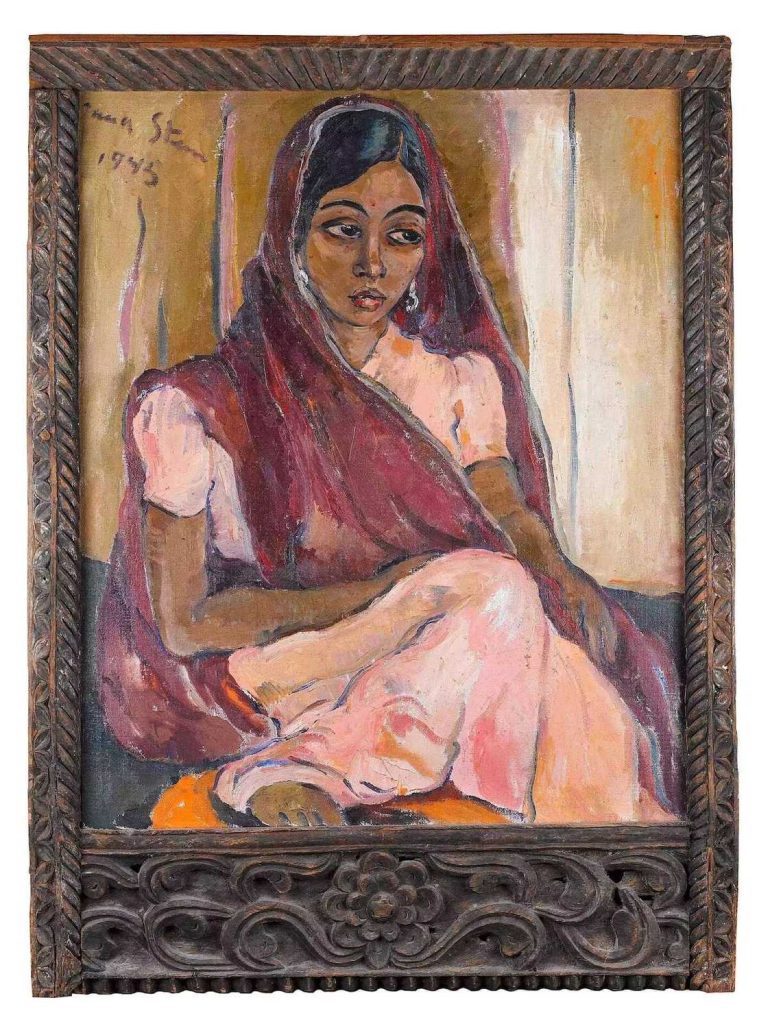
Irma Stern’s Bahora Girl (oil on canvas, 87 x 71cm) is the most frequently referenced work within South African Modernism. This painting solidified Irma Stern’s success within the international art scene. Painted in 1945, the portrait depicts a member of the Bohra (Isma’ili Indian) community and features a relaxed posture.
In her travel journal Zanzibar, Stern describes the sitter as being ‘tall and slender’, with ‘softly flowing lines’. However, in this painting the subject possesses neither a sense of royal dignity nor subservience. Instead, she appears to simply be resting, in a contemplative position.
Within the original frame, composed of carved lintels, ornamental bosses and borders, the painting has been effectively extended. The angular patterns in the frame complement the fluidity and rhythm of the brushstrokes within the painting to create a unified and sculptural piece.


If viewed out of the frame, much meaning would be lost. The brushwork here is very free-flowing. Thick impasto has been applied using both brush and palette knife, creating peaks and valleys in the paint.
The brushwork displays a sense of rhythm, reminiscent of Islamic calligraphy. Although there is no representational intention in the painting, the brushwork demonstrates this rhythm. Coloured brushstrokes, including orange, plum, dark blue and cream yellow, are applied confidently, purely for their rhythmic qualities.
Although Stern was influenced by her mentor Max Pechstein at the Berlin Academy in the 1910s, taking inspiration from his unconventional colour schemes and linear style found in woodcuts, by 1945 Stern had developed beyond Pechstein. While Pechstein’s Expressionist works evoke a sense of suffering in response to the trauma of post-war Germany, Stern’s Expressionism is very positive and decorative. The painting is bright and full of light, evocative of the Indian Ocean.
Complementary colours have been used in the painting, contrasting warm tones in the sitter’s skin with cool blue greens. Red highlights have also been used to contrast with the green background. As seen in both Fauvism and Die Brücke, strong outline in black clearly distinguish the contours of the sitter.
Despite this, the background is stylised and flat, allowing dramatic naturalistic shading in the face and hands. The composition is slightly off-centre. The sitter appears to be cut off at the waist. In addition, her line of sight is drawn at an angle, characteristic of Stern’s style.
Asymmetry within the composition gives the painting a sense of motion being arrested. It seems as if the sitter has just turned away from doing something. The dynamic angular lines in the background, which suggest interior decoration without explicit depiction, appear to spill over the sides of the frame. This gives a sense of tightly contained energy.
It is difficult to avoid political considerations when analysing this work. The paintings of Zanzibar have been considered problematic within the context of colonial orientalism. There is an obvious emphasis on sensuality, exoticism, and reducing the living community to a visual stimulation.
Furthermore, given that Stern visited Zanzibar in 1945 (under wartime conditions), in a mostly Muslim country where visual imagery may be considered sensitive in relation to religion, questions can be raised about consent, and the power dynamics in relation to colonial observation.
However, Stern herself challenged the notion of categorising people. She writes to friends in Johannesburg: “I am painting dramatic pictures, compositions, and faces — not just types and races.” Despite this, it is questionable as to how much this consideration is reflected in the final piece.
The most radical aspect of this piece is the direct eye contact between the sitter and viewer. This painting does not depict a subject for Stern’s own narrative. Instead, she is looking directly at us.
In October 2010, this painting was sold at auction for £2.37 million, making it the most expensive South African painting to date. However, this title was soon surpassed by Arab Priest (1945), sold for £3.1 million in the following year.
This painting is currently located in private collection in South Africa. Within Stern’s wider oeuvre, it falls in her ‘golden era’ of the 1940s. Her expressive style evolved to become more descriptive, whilst retaining a personal complexity and vivid application of colour.