

Within ‘Nwantinti’ (2012), the grand scale evocative of Western historic painting is disrupted by the intimacy of the domestic. An 8 foot wide canvas places the viewer within the private space of a bedroom, in which the artist and her husband Justin Crosby have captured an intimate moment. However, as with many pieces of Akunyili Crosby’s more developed practice (formed during a pivotal residency at The Studio Museum in Harlem), this private space is not entirely isolated. Within the richly layered composition containing acrylics, charcoal, coloured pencils and transferred images, intimacy within this relationship intertwines with post-colonial history and international memory.
Multiple ways of reading the image occur when viewing this piece.
Reading from a distance:
Two figures interact within the domestic environment. The figures are depicted in a three dimensional, but slightly flattened style reminiscent of Alice Neel and Kerry James Marshall, but unique to Akunyili Crosby’s style. Charcoal and pastels create a soft, smooth texture on the figures skins, contrasting with hard angular lines in the fabric and architecture around the figures. A look of gentle, calm and loving intimacy occurs between the two figures in the piece.
Reading up close:
The flat areas of colour in the room are broken up into a complex collage of transferred images. Hundreds of images (grid patterns in sepia and blue tones) are printed onto elements of the bedsheets, walls and negative spaces. These images originate from popular media within Nigeria, private family photograph albums, stylish glossy magazines and political history. As is typical within her work, this printing method has strong symbolic meaning. The history and cultural background of Nigeria are not seen as distant memories, but as essential parts of the everyday life of those living in the diaspora. The images have slight blurring and bleeding due to being Xeroxed. This suggests the unreliability of memory, but also their perseverance. Despite being worn down by distance and time, these images remain recognisable.
Naming the work Nwantinti (a term of endearment in Igbo meaning ‘little one’, or ‘precious intimacy’) ties the piece firmly to its cultural context. Therefore, despite depicting an intimate relationship between people of different races, the piece can be viewed through an Igbo lens of love and kinship.
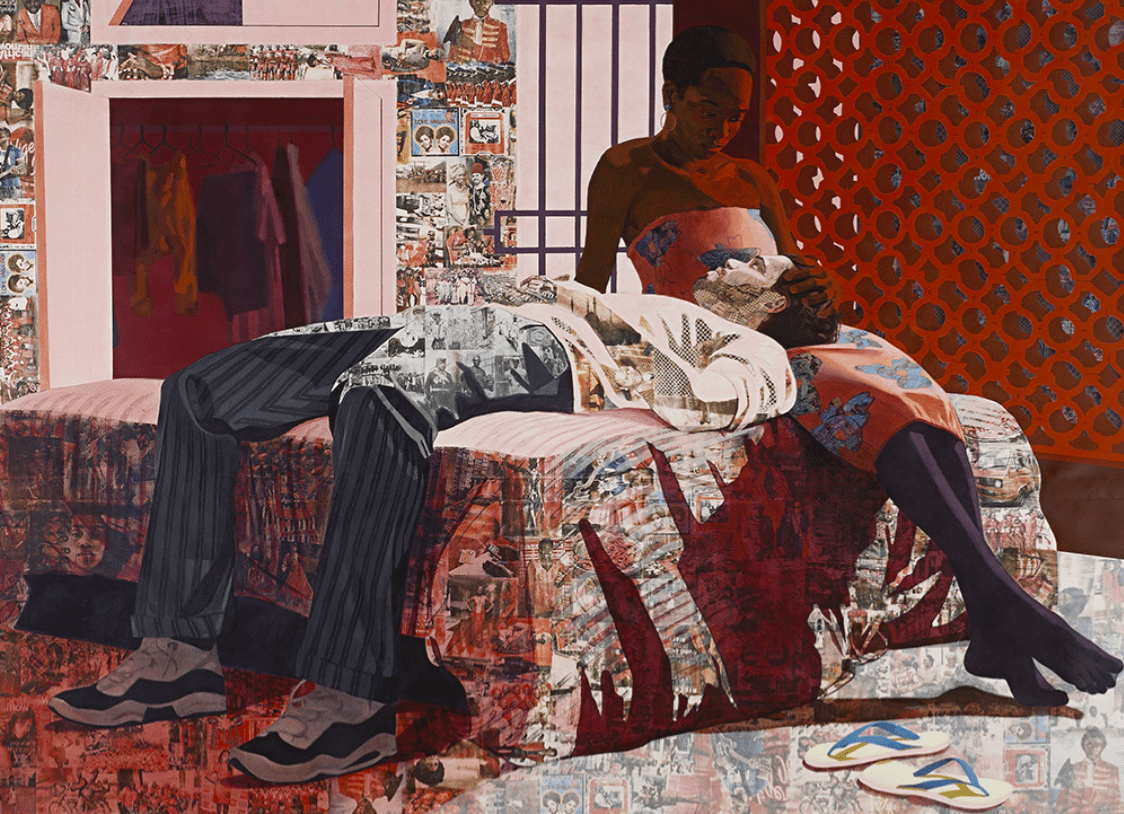
This composition can also be seen as representative of code-switching in post-colonial Nigeria. As in spoken Nigerian English, multiple languages are used in combination (Igbo, Yoruba or Pidgin). In this piece, many differing visual styles merge. The flat textures common in traditional African art, and repeated patterned grid structures of commerative textiles in West Africa (ankara) are combined with realistic perspectives and realism common in western art. Both styles do not overpower one another: rather, both are present on the delicate surface of the paper, and find balance within this piece.
‘Nwantinti’ was created during a pivotal point in Akunyili Crosby’s career. This piece demonstrates why her work has become so influential within contemporary figurative paintings. It combines personal and political themes within the piece without any overt political statements. Rather than being explicit, political themes exist through the representation of black interiors, intercultural love and the creation of a visual record of Nigerian culture within American art.
By combining grand public fresco style artwork with delicate paper based media, Akunyili Crosby creates a lasting historical record from a simple private moment. ‘Nwantinti’ makes clear that even within the simplest of spaces in our lives, there exist layers of memory, pop culture icons, family histories and cultural influences.