

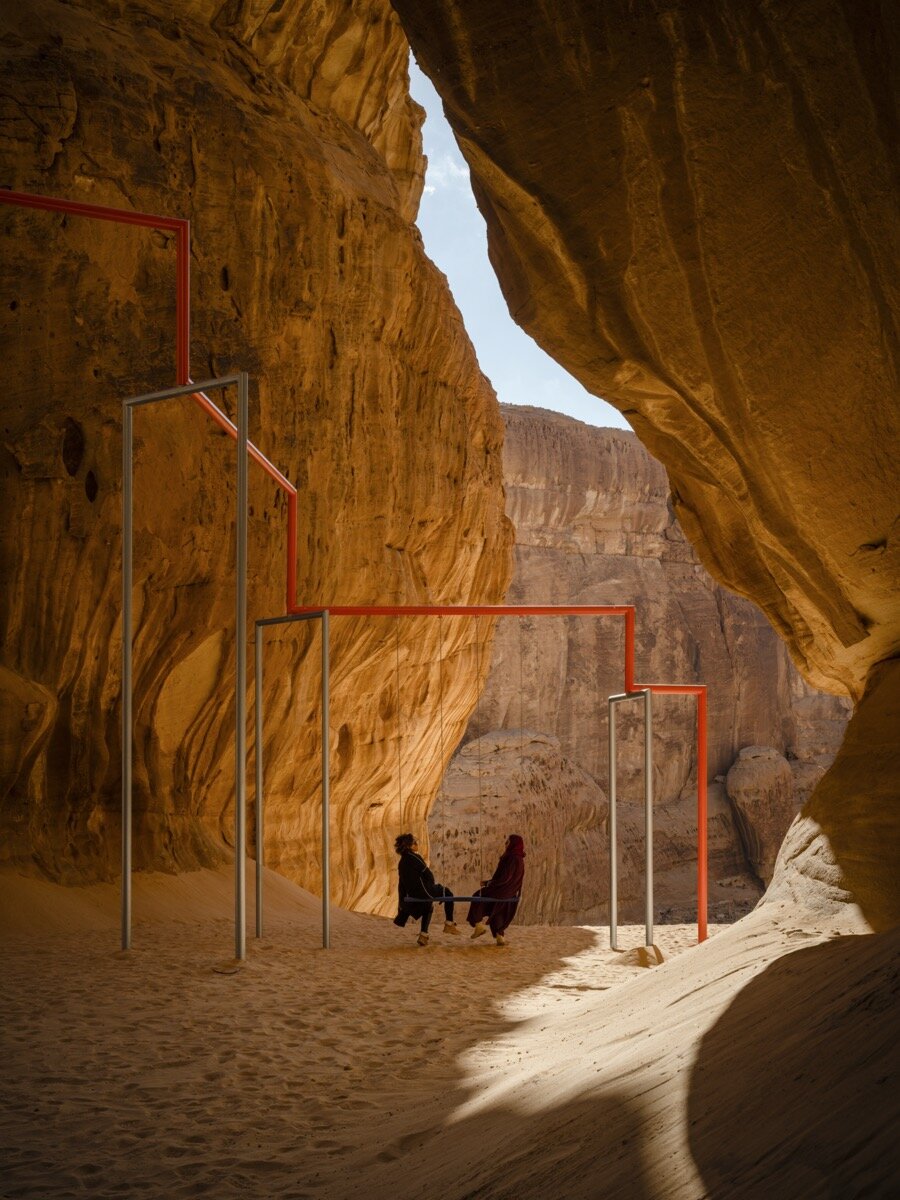
The first thing that struck me was how little the installation tries to announce itself. It set against enormous rock formations, the metal frames read almost with unfinished doorways, the outlines of buildings that were never completed. They don’t compete with the canyon in size or appearance. They introduce a different kind of structure into the environment, it feels like an architectural but it remains open and exposed.
What changes the work most is the two people sitting between the structures. Without them, the installation might feel like a collection of metal frames dropped into a canyon, impressive but distant. Their presence gives the work a sense of scale, but it also brings a quieter moment into the photograph. They seem to be sitting opposite each other, perhaps in conversation, and the installation becomes less like something to look at and more like somewhere to spend time. This is where the piece becomes most interesting to me. The artwork is tied to an ordinary human activity, talking, resting and sharing a space, rather than to its physical appearance alone. The frames become a backdrop for a small, intimate exchange, and that exchange gives the whole scene its meaning.
The positioning of the frames follows different heights and angles, and the red and grey structures appear to move across the space rather than form one continuous shape. The eye follows their outlines from the taller frames down towards the smaller ones. The arrangement almost resembles a staircase, although it does not lead anywhere in the conventional sense. It creates a sense of direction without offering a clear destination, which I find quite compelling. The colours also work in a subtle way. The red frames seem to borrow warmth from the surrounding sandstone, blending with the landscape while still standing apart from it. The grey frames are quieter and stand out more calmly. Together they create a rhythm across the space that keeps the viewer’s attention moving.
The landscape is so dominant that the installation almost feels like it is responding to it. The warm sandstone, the narrow opening of sky and the shadows across the ground create a setting very different from the places where we normally encounter architectural structures. Rather than being placed on the land, the frames feel as though they are in dialogue with it. The photograph also captures sunlight entering from the right, lighting parts of the ground and creating a sharp contrast with the darker areas of the canyon. This gives the scene a sense of time. It feels like a moment that is slowly changing as the light moves, and the installation changes with it, never looking quite the same from one hour to the next.
What I appreciate most about One Two Three Swing! is that it does not immediately tell you what to do or what to think. The frames could be read as structures, markers, pathways or simply shapes placed within the landscape. That openness is what makes the work approachable, especially with people sitting inside it. It isn’t trying to make the desert look more beautiful, because the landscape already has its own presence. Instead, it adds a small human intervention to an enormous natural setting. The work leaves me thinking about how little is sometimes needed to change the way we experience a place. A simple structure, or a shared moment between two people, can make us look at our surroundings differently. In that sense, the installation is less about the frames themselves than about what happens in and around them.