

Madolo and the Aardwolf juxtaposes two different survival strategies. Madolo is a recurring character in Ndzube’s ‘Mine Moon’ universe. He has appeared in previous works and is a characterised as a wanderer who explores Ndzube’s imagined post-apartheid world. The aardwolf, a creature found in South African bushlands, has its own strategy of survival. Unlike the spotted hyena and lion which dominate as predators in their environment, the aardwolf eats termites.
Unlike large works in Ndzube’s 2020 series, such as The Bloom of the Corpse Flower and Assertion of Will, this work is square in format (59 x 59in). The painting contains a layered surface, characteristic of Ndzube’s ‘additive aesthetic’. The base layer is painted in acrylic, and on top of this, collage elements of photographs are layered (eyes, hands and partial faces). These are then painted over to integrate with the fantasy elements within the work. Duct tape patterned elements create the illusion of water within the piece. Textile elements have also been incorporated into this work. Stiched and draped fabrics hang from the canvas, and in some cases extend beyond the edges of the canvas. This blurs the boundary between painting and sculpture, something Ndzube has played with since Becoming in 2016, exhibited by Whatiftheworld in Cape Town.
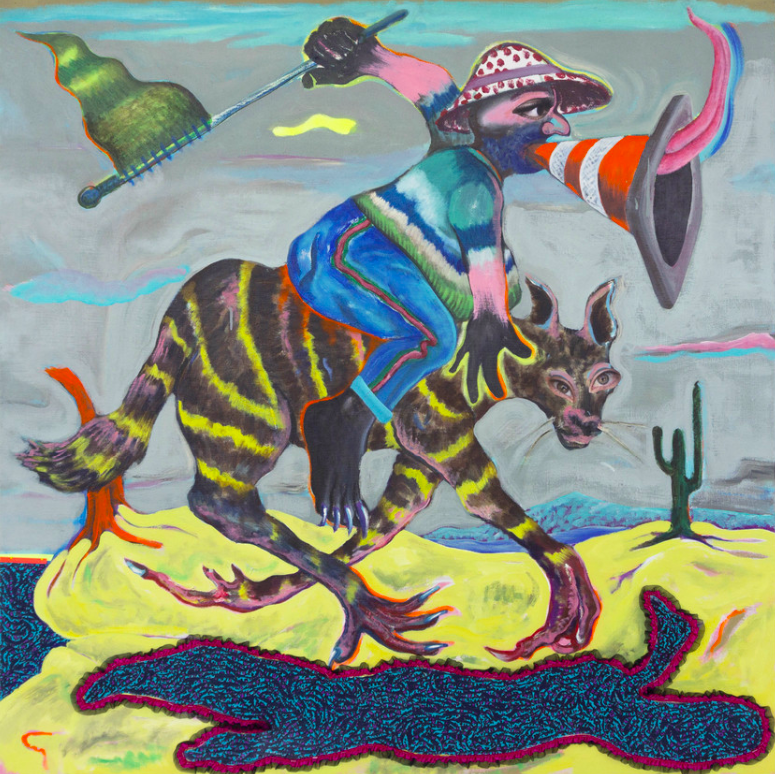
Where works in Ndzube’s 2020 show with Nicodim, Like the Snake That Fed the Chameleon are more showy in style, Madolo and the Aardwolf is much more restrained. The palette is very similar to other works in Ndzubes’ oeuvre, with pinks, bright blues and intense greens. However, unlike in other works, figures are not depicted with such exuberance. If the aardwolf is present as a figure in this piece, it acts as a subtle contrast to Madolo. The tension in the piece lies between subtlety and overt display.
Whilst Ndzube has made it clear that the ‘Mine Moon’ is not an escapist narrative, but rather a ‘vehicle of truth’, he draws upon the magical realism of writers like Ben Okri, Gabriel García Márquez and Zakes Mda to depict the dehumanising processes faced by black workers within the mining industry during Apartheid and beyond, without using a documentary style. The aardwolf eating termites, the most despised and neglected creatures within the ecosystem, can be read as a metaphor for black South Africans having to create lives for themselves from the waste of the dominant society. It is a metaphor for strategic survival.
The use of duct tape within this work, a material used to mend things, creates the illusion of water and therefore suggests that the waste in this piece is being transformed into sustenance. The textiles used within the piece are likely from Ndzube’s childhood in South Africa and therefore add a personal history to the fictional landscape. Finally, the collage technique used within the piece creates a layered effect. The photographic elements are layered beneath painted elements, creating a sense of archaeology. Whilst real elements exist within this piece, they are hidden and require careful observation to be revealed.
There have been criticisms that in using a fictional narrative to depict real histories, Ndzube may be oversimplifying these histories. The ‘Black joy’ label given to much of Ndzube’s figurative work (such as Oracles of the Pink Universe in Denver Art Museum, 2021) has been criticised for erasing the pain and systemic violence within post-apartheid life. However, Madolo and the Aardwolf holds a more sombre tone than many other works of Ndzube’s. It highlights that quiet perseverance does not equate to success. In this piece, the aardwolf does not succeed.
Ndzube describes his work as a ‘kaleidoscope, where brutal reality and hallucination become intertwined’. Within his 2020 works, Madolo and the Aardwolf is perhaps the best example of this. It requires the viewer to consider two truths at once; the landscape is fictional, but the situations it is metaphorical of are real.