

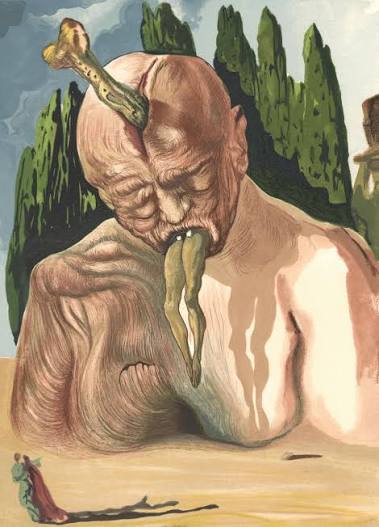
The unusual appearance of the human body forms the central subject of Salvador Dalí’s The Logician Devil (1951). The Spanish artist depicts a giant figure with a distorted head, an elongated horn-like structure, and a long tongue extending from its mouth. A much smaller human figure stands in the lower-left corner, creating a striking difference in scale. The painting brings together familiar human features and imaginary forms through the visual language of Surrealism.
The central figure occupies much of the composition and immediately attracts attention. Its oversized head, closed eyes, extended tongue, and unusual horn-like structure create a distorted appearance. These features transform the familiar human form into something strange and unfamiliar. The exaggerated proportions also give the figure a dominant presence within the landscape.
The use of colour helps distinguish the different elements of the painting. Shades of brown, cream, and grey appear on the central figure, while green and blue dominate the surrounding landscape. These contrasting colours separate the figure from its environment and emphasise its unusual appearance.
The landscape consists of tall green trees, mountains, and an open blue sky. These natural features create a recognisable outdoor setting. Their realistic appearance contrasts with the imaginary central figure, bringing natural and surreal elements together within the same composition.
The small human figure in the lower-left corner introduces a noticeable contrast in scale. Its position beneath the giant figure emphasises the enormous size of the central subject. This arrangement also creates a sense of depth and gives the composition a clearer spatial relationship.
Shading and brushwork contribute to the appearance of the central figure. Dalí uses shadows and variations in tone to define its facial features and body. The detailed treatment of these forms creates texture and gives the imaginary subject a realistic appearance despite its unusual proportions.
Dalí explores these ideas through distorted figures and unusual visual arrangements. In this painting, the combination of a giant human form, a miniature figure, and a realistic landscape reflects his interest in transforming ordinary subjects into imaginary images.
The painting combines distorted human features, contrasting scales, natural scenery, and realistic shading to create a surrealist composition. Through these elements, Dalí presents an imaginative interpretation of the human body and its relationship with the surrounding environment.



Comments are closed.