


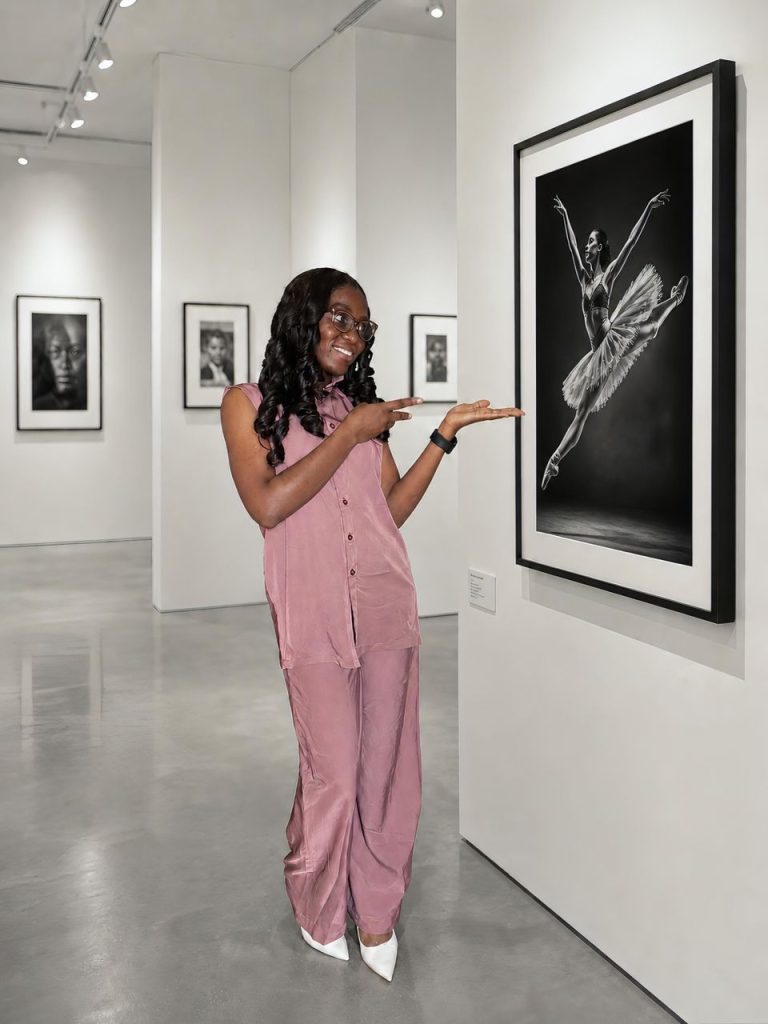
There is a particular fantasy that surrounds great photography, and it’s the
fantasy of the decisive moment, of genius as a natural event rather than a
constructed one. Deborah Abosede Ibeme’s practice is the complete refutation of
that fantasy. Nothing she makes happens. Everything she makes is built. We sat
down with the Nigerian fine art photographer to go inside the process, from the
first word to the final print and understand what it truly costs to make work that
lasts.
Pulsetv: Let’s start at the very beginning of a new series. Where does it come
from? What is the first thing that arrives?
Deborah: A word. It is always a word first. Unfortunately, it’s not even an image. Some
artists say theirs come from a certain kind of mood or feeling. Mine always comes from
a single word that arrives with a kind of weight to it, the weight of something that has
been waiting to be named. Words like inheritance, threshold, remnant, passage. I sit
with that word for a while before I do anything else. I turn it over. I ask what it contains,
what it excludes, what specific visual truth it is pointing toward that I haven’t addressed
in any previous series.
The word is the question. Everything that follows is my attempt to answer it
photographically.
Pulsetv: Interesting. And where do those words come from? Are you looking for
them, or do they find you?
Deborah: Both, depending on the season I’m in. Sometimes a word surfaces from
reading. I move between cultural theory, oral history, poetry, ethnographic literature on
the Niger Delta. Sometimes it comes from memory. A fragment of something I
witnessed as a child that resurfaces decades later, arriving not as nostalgia but as
information. The particular quality of light on a specific afternoon. Once, it was from
watching a particular elderly woman during a reception, the way she moved throughout
the ceremony. Sometimes it’s even the sound a certain fabric makes when it is tied
correctly.
And sometimes it comes from simply watching. A woman in a market whose posture
carries a specific kind of history. A textile in a tailor’s shop that triggers a train of
association I have to follow to its end. I have learned not to rush these moments. They
are not decoration. For me, they’re always the concept arriving in disguise.
Pulsetv: So, once the concept has its word and its direction, what happens next?
Deborah: I start researching. Serious, sustained, systematic research, the kind that
most people outside of academic or curatorial practice would probably find surprising in
its depth. For a series rooted in Ijaw or Urhobo cosmological tradition, which many of
my most significant bodies of work are, I consult ethnographic literature, oral histories,
and the kind of community knowledge that does not exist in any book. I seek out
conversations with elders and cultural custodians. I ask: what did this symbol originally
mean, and what does it mean now, and what is the distance between those two
meanings? Which objects carry active spiritual significance and must therefore be
handled with corresponding accuracy?
As you should know, this is not background research, but primary materials. The
knowledge I gather in this phase becomes the symbolic content of the work. There is a
fundamental difference between an image that uses a cowrie shell as decoration and an
image that uses it as a precise statement about a specific system of value and feminine
power. That difference is entirely determined by the accuracy of what I know before I
step on set. If the knowledge is approximate, the visual language loses authority. And
authority is everything because the work is not simply making an aesthetic argument. It
is making a cultural one.
Pulsetv: How long does this research phase typically run?
Deborah: Three to four weeks at minimum for a major series. For the work that reaches
deepest into the cosmological traditions of the Delta, the most culturally dense material,
it can extend to six or seven weeks before I feel I have a sufficient foundation to begin
visual development. I do not move to the moodboard before I am ready. The research
cannot be rushed without the work feeling it.
Pulsetv: Tell me about the moodboard. What does yours actually look like?
Deborah: It is not what most people imagine when they hear that word. It is not a
Pinterest board or a mood wall of pretty images. It is an argument, much like a visual
essay assembled from sources as diverse as Old Dutch Master paintings, Yoruba
egungun masquerade photography, West African textile archives, contemporary African
fine art, botanical illustration, architectural photography. The juxtapositions I create are
deliberate and analytical. I am looking for intersections between traditions, the visual
rhymes between a Rembrandt shadow and a Niger Delta ritual posture, the formal
similarities between how a Flemish still life treats objects and what I want to do with a
clay vessel in a frame.
And note that, I do not borrow from these references, I only converse with them.
Learning from traditions that solved certain visual problems with extraordinary
sophistication, and then applying those solutions to subject matter those traditions never
engaged with. The result, I hope, is something entirely new: a visual language that
carries the technical intelligence of European painting history and the cultural
intelligence of West African cosmological tradition simultaneously, without either
dominating or displacing the other.
Pulsetv: And the color decisions, when do those happen?
Deborah: At the moodboard stage, and they are locked in early. A series about grief
pulls toward cooler, darker tones within the palette. A series about power leans into the
warm, the rich, the resonant. These are not intuitive decisions that I make on the day of
the shoot. They are analytical decisions made during the research and moodboard
phase, and they are held consistently through to the final print.
Pulsetv: Let’s talk about subject selection, because this is something that
distinguishes your practice very sharply. You are clearly not casting in any
conventional sense.
Deborah: No. Not at all. Most photographers select subjects based on availability, on
physical appearance, on the technical requirements of the frame. I select subjects
based on presence, and I am willing to wait as long as it takes to find the right one.
What I am looking for is women whose bodies already carry the specific quality that the
series is examining. Not as a characteristic they perform, as something they simply are.
A quality so deeply embedded in their physical reality that the camera cannot help but
find it. The woman whose posture communicates ancestral weight without being
instructed to. The woman whose hands, even at rest, carry the knowledge of labor and
ceremony. The woman whose face, in stillness, contains the specific emotional territory
the series is navigating.
Pulsetv: How do you recognise that quality when you see it?
Deborah: Five years of looking. I don’t know how to explain it as a method because it
isn’t a method. It’s a developed sensitivity. My collaborators have described it as almost
uncanny, this ability to see in a brief meeting or even in passing whether a particular
woman has what the work requires. I think what I am actually reading is a kind of depth,
evidence in the body that there is a significant interior life, a significant personal history,
a relationship to the themes I am working with that is real rather than constructed.
Pulsetv: And then what? Once you’ve found that person?
We don’t shoot. Not yet. There is a period of relationship-building before the camera
appears. I meet with the subject, I speak with her and it’s not about the shoot, not about
what I need from her, but about her life, her history, her relationship to the themes the
series is exploring. And it’s not like I am conducting an interview, just building trust and
learning.
What I learn in those conversations appears in the work. It appears in the specific
quality of presence she brings to the set, in the sense that the woman in the frame is not
a model performing something but a person being something. The photographs look the
way they look because the women in them are the way they are, and they are the way
they are in the frame because of the work done before the frame existed.
Pulsetv: This is definitely none that can be replicable. So when you finally get to
the set, what is that environment like?
Deborah: Quiet. A very particular kind of quiet.
I do not play music. I do not have extended conversations with my team while shooting.
The atmosphere I try to create is one of focused, almost ceremonial attention, a quality
of collective concentration that signals to everyone present, and most importantly to the
subject, that what is happening in this space is significant. That it deserves this quality
of attention. That nothing is incidental.
With my subject, I speak quietly and infrequently. Not because I am withholding but
because I understand that direction, in the conventional photographic sense, is not what
I am after. I am not constructing a pose. I am not arranging a body for compositional
purposes. I am creating the conditions in which the subject can simply be fully
themselves. And then I am watching carefully, patiently, and waiting for the moment
when presence crystallises into something the camera can hold.
Pulsetv: You shoot between 200 and 400 frames per session, but a full day might
yield one final image. To some photographers, that sounds like an extraordinary
level of waste.
I’ve got this same question a couple times before, but that question actually
misunderstands what the other 398 frames are for.
They are not failed attempts at the one. In fact, they are the path to the one, the
necessary exploration without which the right moment cannot be distinguished from the
almost-right moment. The one image that survives is the one because of the 399 that
preceded it. You cannot arrive at the true without first fully mapping the territory of the
almost-true. The process is the discipline, and the discipline is the guarantee of quality.
I am not interested in efficiency on set. I am interested in finding the image that needs to
exist. Those are not the same project.
Pulsetv: Deep perspective. Now, let’s talk about the materials, the fabrics, the
objects. You source everything yourself?
Deborah: Always. This is non-negotiable for me.
I visit fabric markets in Warri and Lagos with the specificity of someone who knows
exactly what she is looking for, not just the right color or pattern but the right textile, with
the right provenance, carrying the right cultural associations. Aso-oke. Akwete. Wrapper
cloths produced by specific communities using specific traditional methods. The
difference between these fabrics and their commercially produced approximations is not
merely aesthetic. It is semantic. An akwete cloth woven by an Igbo weaver using
inherited techniques means something that a machine-printed imitation of it does not.
The image knows the difference, even if the viewer does not consciously register it. The
accuracy is in the air of the frame.
I collect objects the same way. Clay vessels from specific pottery traditions. Cowrie
shells arranged with symbolic intention. Ritual implements that belong to specific
ceremonial contexts. Almost five years, I have assembled a collection of materials that
is itself a kind of archive, which is a physical library of symbolic objects I draw from and
add to with each new series.
Pulsetv: When you move into post-production, you have described it as finishing
a painting rather than processing a photograph. Can you explain that distinction?
Processing implies the application of technical corrections to an image that is essentially
already complete. What I do in post-production is a continuation of the image-making
itself, that is, a phase of the authorial process that is as creative and as
decision-intensive as anything that happened on set.
I begin in Lightroom with the tonal structure, working until the image achieves the
specific quality of light I was building toward from the concept stage. I call it “the weight
before the ceremony”. Warm. Dense. Full of implication. The kind of light that exists in
the hour before something irreversible occurs. I know it when I find it. Finding it requires
a sophisticated understanding of how tonal adjustments interact, how reducing
highlights while deepening shadows creates interior space in the image, how the
specific temperature of warmth I apply becomes not a filter but a physical property of
the light itself.
Then Photoshop, for the more precise work. And critically, the management of skin
tones. Ensuring that the rich, dark skin of my subjects is rendered with the same
luminosity and detail that European portrait painting gave to lighter complexions and
that photography has historically failed to provide to darker ones. This is a technical act
and a political act simultaneously. I am correcting, through skill and intention, a
systematic failure in how photographic technology was designed and how it has been
applied. I do not consider this optional.
Pulsetv: From the first word to the final print, how long does a full series take?
Three to five months. Which in the contemporary photography world, where the
expectation is constant content, constant posting, the visual equivalent of a news cycle
is considered almost incomprehensibly slow.
I am not interested in those standards. I am interested in the standards of art which is
the older, more demanding and more permanent standards that measure a work not by
how quickly it was produced but by how long it holds its power.
Pulsetv: And you believe that slowness is directly connected to the holding
power?
Not in the literal sense, but I know it is. The work that lasts is the work that was given
the time it needed to become fully itself. I produce no series I am not entirely ready to
produce. I mount no exhibition I am not entirely satisfied to stand behind. The result is a
body of work with a consistency of quality that I believe could not have been achieved
any faster.
I am not making photographs for the first look. I am making them for the twentieth look,
the hundredth look, for the moment twenty years from now when someone takes a print
off a wall to move house and stands with it in their hands for a moment longer than they
intended, struck again by something they cannot fully name but cannot put down.
That is the photograph I am making, every time. With every frame I select from the 398 I
do not.
The process is long to make the work permanent.
For me, the equation has always been simple.