


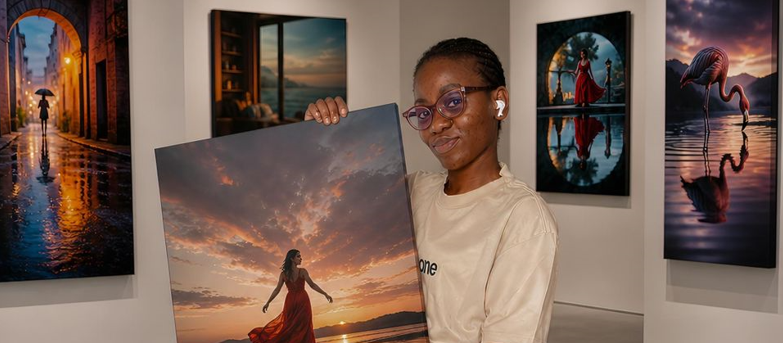
There are certain kinds of artists that do not just arrive, the kinds that accumulate.
Slowly, deliberately, piece by piece, until the world turns around and finds them already
there.
And you know another known fact? Warri does not produce passive people.
There is particularly something in the air of that city, compressed, electric, layered with
the residue of a hundred different stories happening simultaneously, that either hardens
you or sharpens you. In the case of Deborah Abosede Ibeme, it did both. It gave her an
eye that refuses to look away and a patience that refuses to be rushed. It gave her the
understanding, early and without ceremony, that beauty in the Niger Delta is not a
decoration. It is a survival strategy. It is a declaration. It is, sometimes, the only form of
dignity available.

She was born into a family that understood this. Her household was one where
creativity was not an elective, and both craftsmanship and cultural expression were
practiced the way other families practice prayer: regularly, seriously, with the
understanding that something larger than the individual was being served. This
environment did not make her an artist. But it made her someone who already knew,
before she had the language for it, that the world could be arranged into meaning. That
the way something was presented was never separate from what it was saying.
She came to photography through fashion and styling, and it wasn’t behind a camera
but beside it instead, developing the eye before she developed the hand. She
understood proportion, symbolic weight, the grammar of adornment, what the choice of
a particular fabric against a particular skin at a particular angle could communicate
without a single word. She eventually adopted the camera to formalize what she had
already been doing for years in her mind. So, safe to say, unlike how a few others may
perceive, it was not a discovery.
The turn toward fine art photography happened around 2019 and 2020, not as a student
making a first attempt, but as a woman making a considered choice about what her
creative life would be for.
What drove that choice was absence. Don’t mistake it for a distance from the industry
because she was already within it, already working. It was instead the absence she kept
encountering in the images around her. The absence of the Niger Delta woman
photographed with the gravity she deserved. The absence of African “femininity” treated
not as texture or backdrop or cultural spectacle but as the full, complicated, spiritually
dense subject of serious art. She had seen African women in front of lenses her entire
life. She had rarely seen them “seen”.
Albeit that gap, it didn’t turn her bitter, she learned to become methodical. She
understood that the answer to an absence is presence, not loud, not argumentative, but
sustained and undeniable. She would produce work that made it impossible to continue
that particular oversight. She would build a body of work that did what she needed it to
do: hold the Niger Delta woman in the light she was always owed.
Deborah began professionally in 2020. Within two years, her work was on the walls of
the Nike Art Gallery in Lagos which is one of Nigeria’s most significant cultural
institutions, as part of her solo exhibition “Where Ancestors Still Breathe.” The title was
not poetic decoration. It was a declaration of the philosophy that would anchor
everything she would produce: the past is not behind us. It is inside us. It breathes
through us. And if you look carefully enough, you can photograph it.
A Deborah Abosede Ibeme photograph does not feel taken. It feels made following the
deliberate assemblage of a sculptor, and the precision of someone who understands
that every element in the frame is either earning its place or undermining the whole.
She works primarily in studio environments she designs herself, building sets from
hand-sourced traditional fabrics, ritual objects, clay vessels, cowrie shells, and symbolic
material drawn from the cosmological traditions of the Niger Delta. The Ijaw water deity,
the Urhobo masquerade, the ancestral feminine. She is fluent in what they mean and
insistent on using them correctly.
Her subjects are not models in the commercial sense. They are women she selects with
the precision of a casting director who is also a cultural historian. Women whose faces,
postures, and presences carry the specific weight the work requires. Before the camera
is shot, she spends significant time simply with them. She speaks little during sessions,
not an awkward silence. It’s with it that she builds the conditions in which something true
can happen.
According to Deborah, she shoots between 200 and 400 frames per session, selects
with a severity that would unnerve most photographers. She acknowledges that a full
day of production might yield only one final image. Occasionally two, which she doesn’t
consider wasteful but honest.
By 2026, Deborah Abosede Ibeme has produced over fifteen major conceptual
photography series, each a sustained, thematically coherent examination of one
dimension of African womanhood, cultural inheritance, or spiritual identity. She has
mounted solo exhibitions across Nigeria and the United Kingdom: from the Thought
Pyramid Art Centre in Oghara to the CasildART Gallery in London, from TessArt Gallery
in Asaba to the African Centre in London. She has participated in group exhibitions on
four continents; New York, Nairobi, Ghana, Dubai, Uganda alongside some of the most
compelling voices in contemporary African visual art.
Her gallery works; Strength of The River Mother, Under the Ancestral Moon, Veiled Majesty, The Good Effect, Grace Between the Stalls, are priced between $4,500
and $5,500 and held in private collections across Nigeria, the United Kingdom, the
United States, and Canada. These are not decorative purchases. Her collectors are
people who acquire art because it holds something they cannot find elsewhere, a
particular truth, recognition, or weight.
She has received recognition from institutions that matter: the Delta State Fine Art
Photography Awards, the Ministry of Art and Tourism Nigeria Photography Prize, the
National Emerging Artist Award (shortlisted at Studio24, Lagos), a Merit Award from the
United Bank for Africa, and the Rising Talent Recognition from the Niger-Delta Creative
Arts Platform. Each of these honors arrived not as a surprise but as a confirmation —
the industry catching up with what the work had already said.
She has directed visual productions for cultural institutions including the Asaba Museum
and the Igue Festival in Benin City. She was commissioned by the Ministry of Tourism in
Abuja in September 2024 to produce editorial photography for national archival
purposes, a commission that places her work not just in private hands or gallery walls
but in the official cultural record of her country.
She has mentored over fifty emerging photographers, facilitating workshops and
one-on-one training sessions across Delta State, building the informal infrastructure for
a next generation of fine art photographers who might otherwise have no access to this
world.
There is a difference between a photographer who makes beautiful images and a
photographer who produces necessary ones.
The distinction matters because it determines how the work functions, whether it
decorates or whether it demands. Whether it settles into the room or whether it
rearranges it. Her photographs do not settle. They arrive with a kind of quiet authority
that takes up space in the way that truth takes up space: that is, in a way that makes it
impossible to continue exactly as you were. In other words, Deborah Abosede Ibeme
produces necessary images.
This authority was not given to her. It was built through years of conceptual rigor,
through the discipline of working with limited resources without allowing those limits to
touch the vision, through the sustained courage required to refuse the commercially
safe option in favor of the culturally honest one. Through showing up, exhibition after
exhibition, in galleries from Ughelli to London, and offering the same uncompromised
work in every room.
She is just in her thirties and already five years into a practice that most photographers
spend a decade trying to establish. She has a collector base that spans four countries.
She has a visual language that is immediately recognizable, not because it is flashy but
because it is “hers” in the deepest sense: rooted in a geography, a history, a spiritual
cosmology, and a philosophical position that no one else occupies in quite the same
way.
She is not becoming. She has become. And what comes next? the international gallery
representation she is building toward, the fine art monograph she is planning, the
creative foundation she intends to establish for emerging African photographers, that
will be an expansion of something already fully in motion.
The global art world’s relationship with African photography is, in 2026, at a genuinely
significant inflection point. Institutions that spent decades treating African contemporary
art as a curiosity or a subcategory are now scrambling to catch up, to acquire, to exhibit,
to engage with a body of creative work that has been building in depth and
sophistication for decades without their attention.
In that context, Deborah Abosede Ibeme has worked her way to become both an
interesting artist and an argument. Her practice argues that African fine art photography
can be conceptually rigorous and culturally specific simultaneously. That the more
rooted in the particularity of the Niger Delta her work becomes, the more it resonates
globally. She argues, through every frame she produces, that the African woman is not
a subject waiting to be discovered by the right Western eye. She is the author of her
own image, and some of the most important visual documentation of that authorship is
being produced right now, in a studio in Warri, by a woman who decided, five years ago,
that absence was no longer acceptable.