

Standout artwork in the gallery is Yinka Shonibare CBE’s, Woman Shooting Cherry Blossoms (2019). Comprising one-of-a-kind fibreglass, the 244 x 193 x 436cm statue depicts a woman wearing a puffed Edwardian Dutch wax print cotton gown. She holds a rifle the end of which sprays out an entire coloured cherry blossom bough. Moreover, the subject’s head is an artist-designed, hand-painted sphere listing the names of 92 women who have contributed to the enhancement of women’s rights. Instantly, the work moves away from becoming purely aesthetic and becomes overtly political. Fabricated using metal, brass, zamak, wood, resin and silk, this artwork was specially created for the re-opening of Fukuoka Art Museum. It was initially exhibited in the artist’s first ever solo exhibition in Japan (Flower Power, 21 st March – 26 th May 2019), and marked his first Japanese themed artwork.
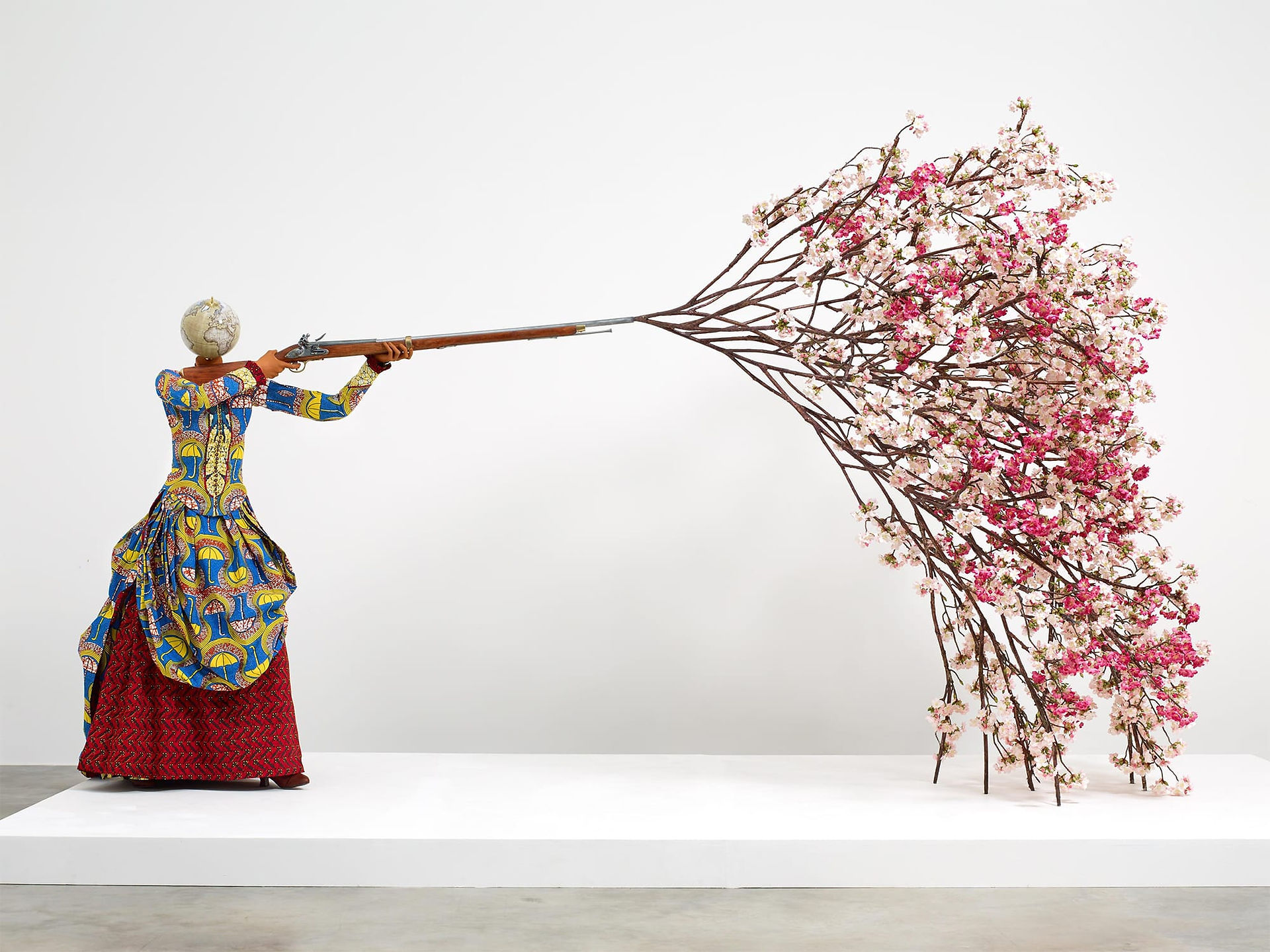
Whilst seemingly disparate, the artwork’s ingenuity rests in its ability to combine elements of inauthenticity. Dutch wax print fabric is a colonial commodity. It was originally inspired by Indonesian batik, mass-manufactured in the Netherlands and then re-exported to West Africa. By the 1960s it had been re-appropriated in Africa as an icon of African independence. Furthermore, Edwardian fashion style is of European origin, and cherry blossom is representative of Japan. The artist combines these varied components into one body. Consequently, the finalised artwork is neither distinctly African, European or Japanese. Rather, it exists as a postcolonial ‘in-between’ which cannot be owned by one nation. Likewise, although Shonibare frequently incorporates the ‘globe head’ in his figurative works, it removes a person’s particularity and generalises it. In doing so, it prevents the artwork becoming singular in nature.
Whilst previous Shonibare installations (for example, the Scramble series and Mrs Pinckney sculptures) have emphasised themes of exploitation, this artwork consciously subverts that. Instead of shooting bullets – instruments of imperial and male authority – the gun shoots forth a bough of blossoms. Softer, more aesthetically pleasing objects are thus employed as instruments of power. Crucially, this underlying contradiction is not smoothed over. The figure is captured in a ‘heroic struggle’ pose. Neither victorious nor vanquished, she embodies the paradoxical state of being caught between two opposing forces. Likewise, the cherry blossom appears to be equally suspended in time, in much the same way as the figure. Therefore, this is why it has been added to the museum’s permanent collection (accession number: 3-G-82, 2019). Rather than functioning as an empowering advertisement, it provides an enduring, complex representation which compels us to engage with, and tolerate, the challenge of existing in a culturally in-between space.
Despite its high quality fabrication, some may argue that the artwork re-uses design features (globe head, Dutch wax print fabric and heroic struggle stance) which Shonibare has consistently used since the mid-2000s. Nonetheless, arguably the artwork most effectively applies these stylistic elements within a particular setting. Not only was it specifically commissioned for a named museum, but also for a particular time of year (cherry blossom season) and within a defined geographical location (Japan). Thus, it successfully channels the artist’s longstanding themes within a unique, localised context. Although large in stature, the artwork lacks any hostile attributes. Likewise, although the palette is rich, it eschews mere ornamentation. Fundamentally, it is acutely aware of, and can therefore relate to, its target audience – namely, the postcolonial, internationally minded, culturally in-between person. Most importantly, it does so in an approachable manner.