

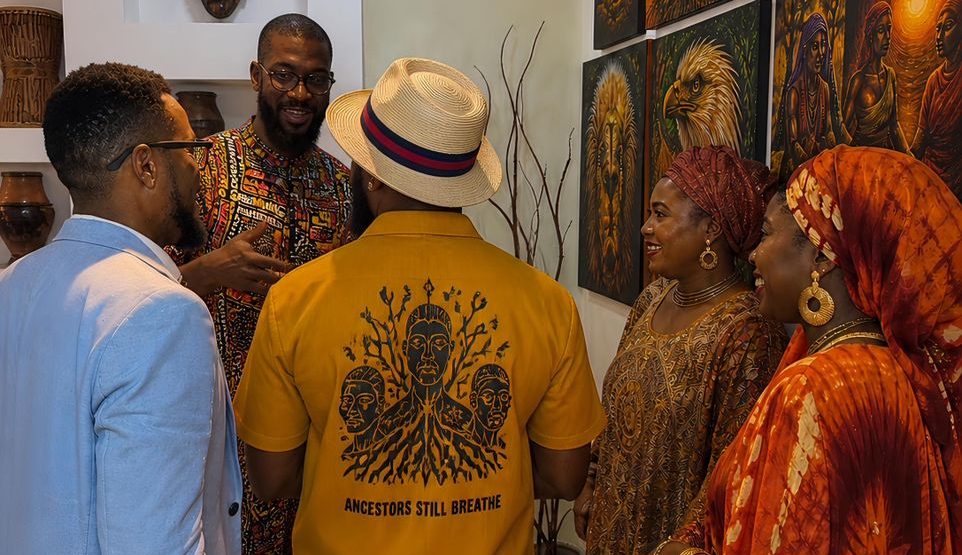
On a Tuesday evening in March, the Nike Art Gallery on Lekki Expressway fills with the
particular energy of an opening night that feels like more than an opening night. The
crowd is the usual Lagos art crowd, collectors, creatives, critics, the culturally curious.
But there is something in the quality of attention in the room that is different from the
usual. With the usual opening nights where people circulate, loosely organised social
performance around the presence of art on walls. With this exhibition, the atmosphere
was one such that the crowd were standing in front of the photographs, speaking in the
lowered voices that people use when they are not entirely sure what they are feeling but
are certain they are feeling something.
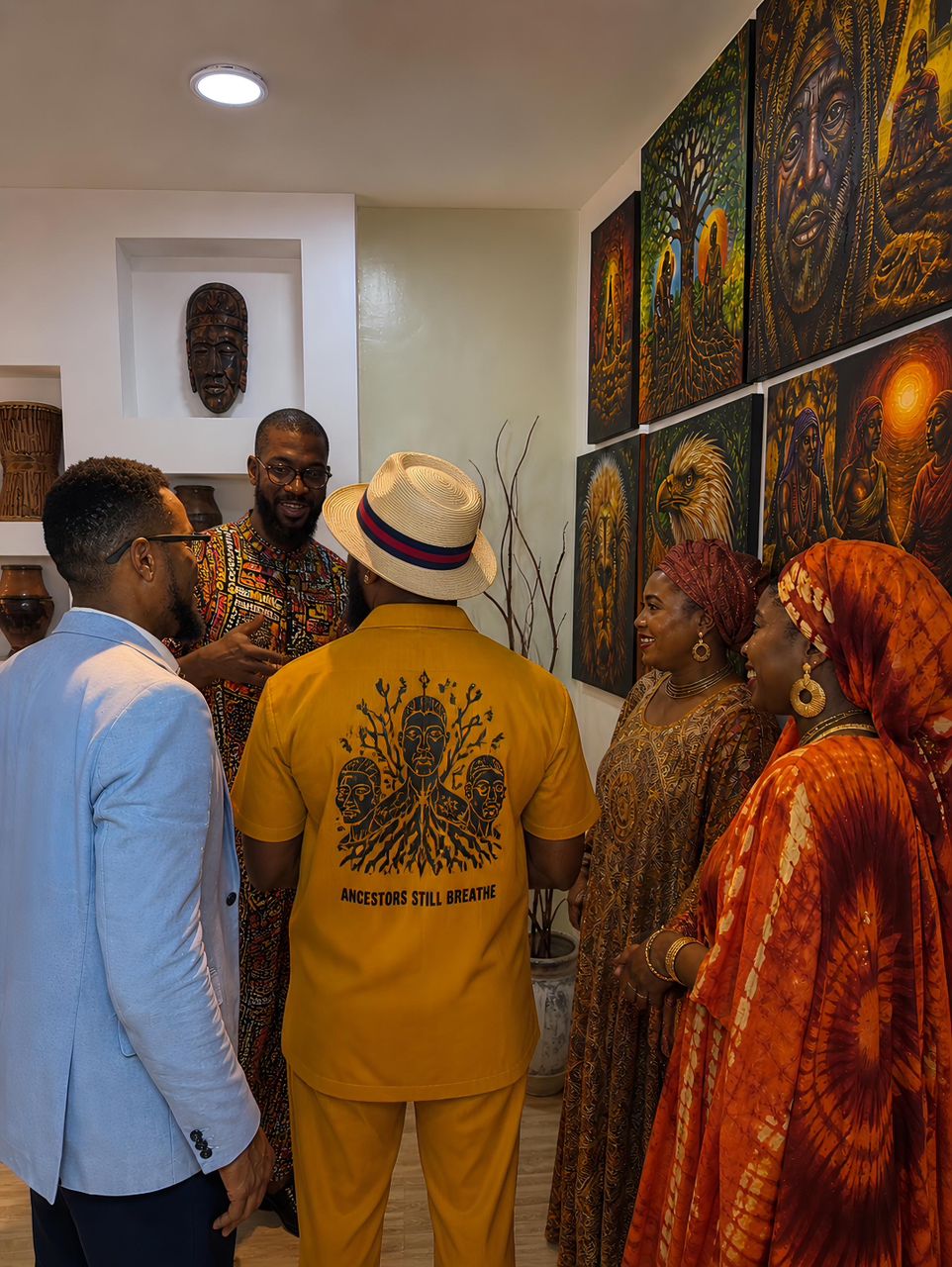
The exhibition titled “Where Ancestors Still Breathe”, a solo show with eight large-format
fine art photographs, each one mounted with the kind of care and spatial consideration
that tells you the person who made them understands that how a work is presented is
part of what the work is saying. The photographer, Deborah Abosede Ibeme is a Warri,
based fine artist. She has been working professionally as a fine art photographer for two
years.
Two years.
It is worth pausing on that before moving any further.
A little note on The Nike Art Gallery shows that the gallery is reputable for showing work
not just because an artist is promising but because the work is ready. This is one of
Nigeria’s most significant cultural institutions, a space with a permanent collection of
over eight thousand works, a history of exhibiting artists whose practices have shaped
Nigerian fine art across generations, and an audience whose sophistication has been
built through years of sustained engagement with the best available. When a
photographer mounts a solo here, the implicit argument of the institution is that the work
belongs in this space, not as a developmental gesture or an early-career investment,
but as a statement of current achievement. “Where Ancestors Still Breathe” belongs in
this space. Completely, without qualification, on its own terms.
The exhibition occupies the gallery with a quality that is immediately present before any
individual work has been closely examined. The light inside the photographs, and it
would be more accurate to call it the light Deborah builds inside the photographs, (since
nothing about it is accidental,) establishes a temperature for the whole space. Warm.
Dense. Carrying the specific weight of a moment just before the ceremony. It is the kind
of light that makes a room feel held rather than simply illuminated, and it draws visitors
toward the works with the mild, insistent pull of something that wants to be stood in front
of.
The subject of the exhibition is announced in the title and explored in the works with a
philosophical seriousness that curatorial language rarely achieves. “Where Ancestors
Still Breathe” takes its name and its central argument from the cosmological tradition of
the Niger Delta, specifically the Ijaw and Urhobo understanding that the ancestors are
not historical figures but active presences. “Not behind us in time, but beside us in
space,” as Deborah herself would assert. Breathing through the choices we make, the
bodies we inhabit, the practices we maintain or allow to slip quietly out of the living
world. This is not metaphor in the tradition Deborah is working within. It is ontology, a
specific and seriously held account of how reality is structured, of who is in the room
and what their relationship to the living is.
The photographs do not illustrate this belief. They embody it. They are built, and built
most definitely fits this context because this images do have the quality of being
constructed, and it is so, to make the ancestral presence tangible. To give it a visual
form that a viewer can stand in front of and feel, in the body, before the mind has had
the chance to organise what is being experienced into something more manageable.
Move into the works themselves and the first thing that demands attention is the use of
symbolic objects. These are not props. That word is inadequate and inaccurate for what
Deborah is doing with the material she places in her frames. Cowrie shells appear in
several of the works, arranged with a precision that is communicative rather than
decorative. In the visual grammar of the Niger Delta, the cowrie carries specific
meaning: value, spiritual protection, feminine power, a cultural currency. When they
appear in these images, they are doing the work of vocabulary. They make a statement
about the woman in the frame, about what she carries and what she is worth, in a
language that the image does not need to translate because the image was built in that
language from the beginning.
Wrapper cloths appear across the exhibition tied with a specificity that communicates to
those who know how to read it, the knot, the arrangement, the choice of fabric itself
carrying information about identity, status, ceremonial context. Clay vessels. Ritual
implements drawn from Urhobo and Ijaw tradition. Each object placed with the care of
someone who has spent serious time understanding what the object means before
deciding whether it belongs in the frame.
This level of symbolic accuracy is one of the most intellectually significant qualities of
the exhibition and one of the most difficult to achieve. Photography has a long history of
using African cultural material, fabrics, objects, adornment as visual texture, as the
signifiers of a generalised cultural identity that adds atmosphere to an image without
adding meaning. “Where Ancestors Still Breathe” does not do this. The objects in these
frames are specific, accurately deployed, and integral to the meaning of the images they
appear in. Remove them and the images lose something they cannot afford to lose.
This is the difference between a photographer who has researched a culture and a
photographer who is working from inside one.
The subjects of the photographs are mostly women. This is not incidental.
The African Womanhood Series, the body of work from which these exhibition pieces
are drawn is built on the understanding that the African woman is not simply a
participant in cultural tradition but its primary custodian. She is the one who knows
which fabric belongs to which ceremony, which object must be handled with which care,
which gesture communicates what to whom in which context. She is, in Deborah’s
framing, the living archive, the breathing, moving, ageing repository of knowledge that
has no other home. Photographing her with the full weight of fine art practice makes an
argument about what she carries and about the value of that carrying. About how long it
has gone unacknowledged in the quality of light it deserves.
The women in these frames have a quality that is immediately arresting and takes
longer to name. They do not appear to be posing. They do not appear to be managing a
relationship with the camera, deciding what to give it, how much to withhold, how to
arrange themselves for the eye on the other side of the lens. They appear, instead, to
be completely and privately themselves. Their postures are vertical, unhurried,
monumental in the specific sense that monuments are monumental and not
ostentatious, but structurally complete. They do not lean toward the camera. They
occupy their space with the ease of women who have never doubted their right to be
exactly where they are.
This quality of private completeness, of a subject who is fully present and entirely
unperformed is one of the most difficult things to produce in portrait photography. When
it appears in a single image it can be attributed to luck. When it appears consistently
across eight works in a solo exhibition, it is something else. It is the result of a working
method, specific and deliberate, an approach to the relationship between photographer
and subject that produces this quality reliably, across different women, different
contexts, and the different symbolic environments. On the opening night, a collector
who had been standing in front of one of the larger works for an unusual length of time
was captured to have said: “she is not pretending.” That statement stood out for me as
the most precise critical observation made in the gallery that evening.
Deborah’s images make a demand that outlasts the first encounter, a quality that
distinguishes work built on genuine conceptual depth from work built on aesthetic
achievement alone. Aesthetically accomplished photography satisfies itself on the first
look. It gives everything it has immediately and the viewer moves on. Deborah’s work
does not work this way. It holds something back, and not coyly, or as a strategy, but
because what it contains is genuinely more than a single viewing can exhaust. The
cowrie shells yield their meaning gradually. The light reveals more of its intention the
longer you attend to it. The subject’s stillness becomes more articulate with time, as if
the image deepens rather than diminishes with sustained looking.
Grace Between the Stalls is the work that stops people at the opening. Not from a
distance, it pulls you in close, and then it holds you there longer than you planned to
stay.
The image is set in a market. A dense, working West African market with produce crates
stacked on either side, colourful tarpaulin umbrellas overhead, the ground beneath bare
and uneven, a city skyline pressing in from the background. Market traders and buyers
populate the frame, watching, what is happening at the centre of the image. At the
centre of the image is a young Black girl in a white classical ballet tutu and pointe
shoes, mid-arabesque, one arm lifted, one extended, her body turned with the precise,
practiced geometry of someone who has given years to this discipline. She is not
performing for the crowd around her. She is not acknowledging the cameras, the stalls,
the noise, or the ground beneath her feet, bare market dirt against which her pointe
shoes make the most quietly radical visual argument in the frame. She is simply
dancing. Completely. As if the space she is dancing in is exactly the space she was
always supposed to dance in.
The collision the image stages is immediate and total: classical European ballet form,
the white tutu, white tights, pink pointe shoes, the vocabulary of a tradition that was built
in European courts and concert halls and has historically had very little room for a body
like hers, dropped without apology into the middle of an African market. The people
around her are not gasping. They are watching with the mixed, practical attention of
people who have seen many things and are deciding what this one is. What Deborah is
examining here is belonging, specifically, the question of which bodies are granted
unconditional belonging in which spaces, and what it looks like when a body refuses to
accept the terms of that question. The girl is not out of place in this market. She is
insisting, through the simple act of dancing in it, that no space has the authority to tell
her she is out of place. The tutu does not belong to the market. The market does not
belong to the tutu. She belongs to both, and the image holds that double belonging as a
fact rather than as a provocation, which is what makes it so much more powerful than
the provocation alone would be.
The title earns its weight in full. Grace Between the Stalls is not grace in spite of the
stalls, it is grace that exists because of them, that finds its fullest expression in the
friction between the form and the environment, between the discipline and the dirt,
between the world that trained this girl’s body and the world her body actually lives in.
On opening night, this is the work people return to. A young woman who came to the
gallery with a group separates from them and stands in front of it alone for a long time.
When she finally rejoins her friends her expression is the expression of someone who
has been shown something she already knew but had not previously seen made visible.
That is the specific quality of recognition that Grace Between the Stalls produces. It
does not surprise, but the more unsettling experience of encountering your own life held
in a frame with this much care and this much precision and this much refusal to look
away from what it actually contains.
By the end of the opening, the gallery has not emptied in the way that opening nights
usually empty. People are still in conversation with the works. The room is quiet in the
specific way that rooms are quiet when something in them is still speaking.
That this is happening at the Nike Art Gallery, that it is the Nike Art Gallery whose walls
are holding these images and whose audience is having this experience is not a detail
that should pass without remark.
Deborah Abosede Ibeme is two years into her professional practice. She is based in
Warri, operating from a state that the metropolitan gallery circuit has historically treated
as peripheral. She did not come through the usual channels, that is the Lagos art school
networks, the gallery assistant routes, the years of group shows building toward an
invitation to a solo. She arrived with the work and the work was sufficient. In an industry
that typically asks artists to spend years proving they deserve serious rooms before
offering them one, the Nike Art Gallery has looked at two years of production and
determined that the standard is already there.
That judgement is correct. And it raises a question that the Nigerian fine art
conversation should be asking: how many artists with this level of seriousness are
working in cities like Warri, in states like Delta, outside the visibility of the metropolitan
circuit — and how long before the circuit extends far enough to find them?
“Where Ancestors Still Breathe” does not answer this question. It is an exhibition, not an
argument. But it makes the question impossible to ignore, because it demonstrates, with
the full authority of the Nike Art Gallery’s institutional weight behind it, that the periphery
the circuit is ignoring is producing work of this quality.
For now, the work is here. On these walls. In this light.
Go and see it before March ends.
Go and give the images the time they are asking for, which is more time than you
planned, and less time than they deserve.
Stand in front of the woman who is not looking at you and stay until you understand why
she does not need to.
The ancestors are still breathing in this exhibition.
You will feel it. The room is full of it.


Comments are closed.