

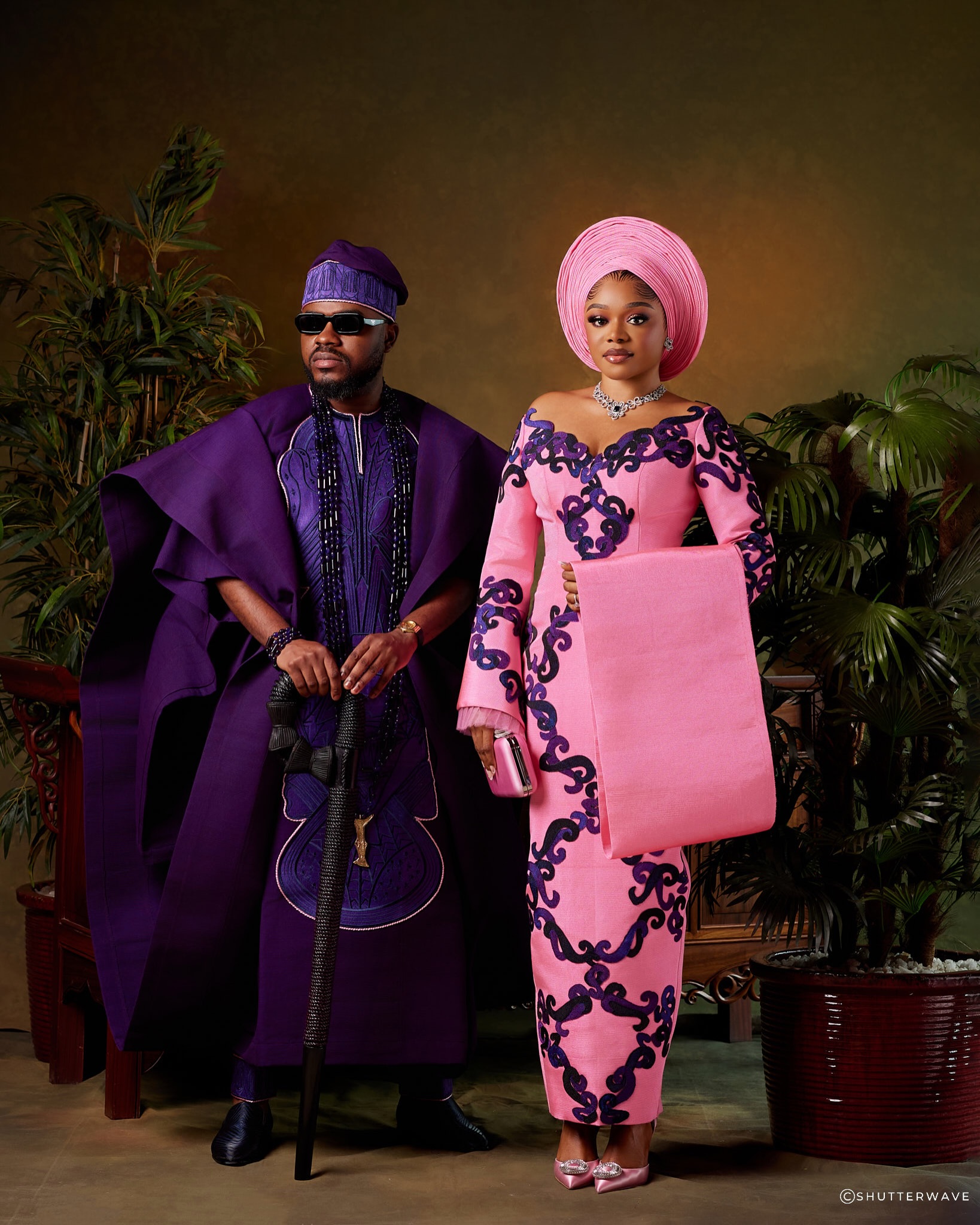
You have chosen your wedding colours. Your partner has picked an outfit they love. You have saved pictures of beautiful couples on Instagram, but when you put your outfit ideas side by side, something feels off. The colours match, yet the looks do not quite come together. Or perhaps both outfits are so elaborate that neither allows the other to shine.
If this sounds familiar, the problem may not be your choice of fabric. It may be how the different elements work together.
For Nigerian traditional weddings, coordinating outfits involves more than buying the same Aso Oke or selecting matching colours. There are silhouettes to consider, textures to balance, embellishments to manage and cultural details that give each outfit its character.
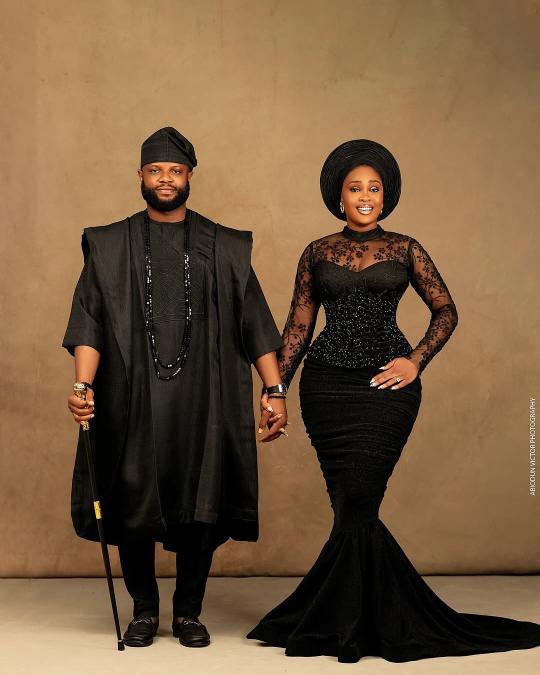
The secret is to think of your outfits as two distinct designs having one visual conversation. They should look connected without looking copied.
1. Choose an anchor, not an identical outfit
One of the easiest ways to coordinate your looks is to agree on a visual anchor: a detail that connects both outfits.
It could be a shared colour, a particular fabric, a shade of embroidery or a metallic accent. Once you have that anchor, each person can interpret it differently.
Imagine the groom wearing a deep burgundy agbada with subtle gold embroidery, while the bride wears a champagne lace gown with burgundy details. They are not wearing identical outfits, but the shared colours connect them.
The same idea works with Aso Oke. One partner could wear it as the dominant fabric, while the other incorporates a related shade or uses it in selected details.
Try this: Before visiting your designer, agree on one main colour and one connecting detail. Let the rest of each outfit reflect your individual taste.
2. Think about visual weight: let one outfit lead in some areas
In fashion design, visual balance concerns how different elements compete for attention. Colour, shape, texture and embellishment all contribute to how visually prominent a garment appears. The Utah State University Extension guide to clothing and textile design explains how these elements work together to create balance and harmony.
This matters when coordinating traditional wedding outfits.
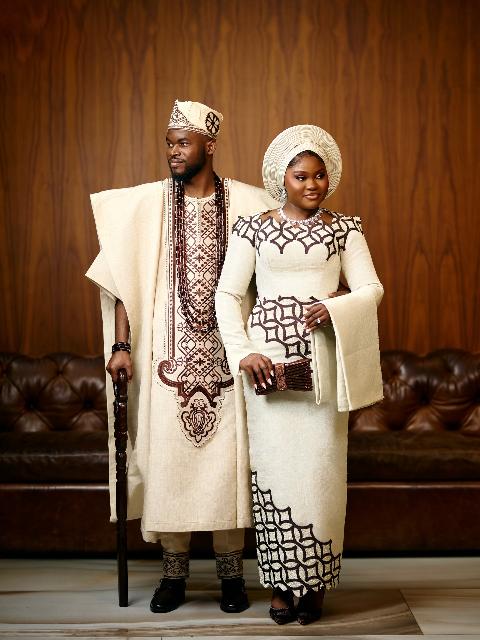
Suppose the bride chooses a dramatic gele, heavily embellished blouse and a richly textured wrapper. If the groom also chooses an oversized agbada with elaborate embroidery, a highly decorative cap and several statement accessories, the overall effect may feel crowded.
Neither outfit is necessarily wrong. The challenge is that both are demanding attention at once.
A more considered combination might pair the bride’s elaborate ensemble with a groom’s agbada that has a cleaner silhouette and more restrained detailing. Alternatively, if the groom’s outfit is the statement piece, the bride could choose a simpler silhouette with carefully placed embellishments.
This does not mean one partner should look less important. It means deciding where the strongest visual details belong.
Try this: Lay both outfit references side by side. If every part of both outfits is bold, identify one or two details that could be simplified.
3. Mix textures instead of matching every fabric
Matching fabrics can create a strong traditional look, but it is not the only way to achieve coordination.
Different textures can make a couple’s outfits more interesting, provided they work together. A richly woven Aso Oke can sit beautifully alongside lace, smooth fabric or a more understated textile. The contrast gives each outfit its own character while maintaining a connection through colour or detailing.
Think of it like decorating a room. If every surface has the same pattern and texture, the space can feel flat or overwhelming. A mixture of textures can create depth and contrast.
The same principle applies to clothing. Fashion design uses texture, shape and colour as distinct elements that can be combined to create visual interest. The Minneapolis Institute of Art’s fashion education guide explores these elements and their role in design.
For example, a groom’s textured Aso Oke could be paired with a bride’s lace outfit that picks up one of its colours. The fabrics are different, but their relationship feels deliberate.
Try this: Choose fabrics together, not separately. Compare their texture, sheen and overall weight, and ask your designer how they will appear side by side.
4. Coordinate silhouettes, not just colours
Two outfits can share the same colour and still look disconnected because their shapes do not work together.
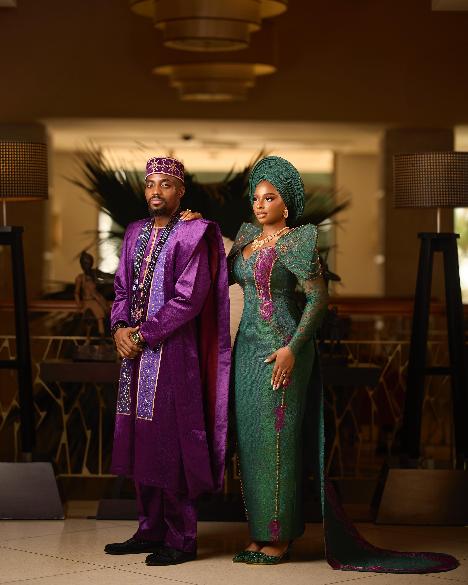
A silhouette is the overall outline of a garment. In traditional wedding fashion, this could mean the volume of an agbada, the structure of a fitted gown, the drape of an iro or the shape created by a gele.
You do not need identical silhouettes. Instead, consider how their proportions relate.
For example, a groom’s voluminous agbada creates a strong, flowing outline. A bride could complement that presence with a structured gown or a carefully draped ensemble rather than trying to reproduce the same volume.
Alternatively, if both partners prefer dramatic silhouettes, the colours and detailing can be more restrained to prevent the overall look from becoming visually overwhelming.
The goal is to make the outfits feel balanced when the couple stands together, not just when each person is viewed separately.
Try this: Look at full-length photographs or sketches of both outfits together. Do not judge the coordination from fabric swatches alone.
5. Give your details a common thread
Sometimes, the difference between two outfits that merely match and two outfits that feel thoughtfully coordinated lies in the smallest details.
Perhaps the bride’s outfit has gold embroidery, while the groom’s cap features a similar gold finish. Maybe a shade used in the bride’s gele appears subtly in the groom’s inner garment. A shared motif or a carefully chosen accessory can also establish a connection.
These details do not need to be obvious. In fact, subtle repetition can be more effective than reproducing the same decoration everywhere.
The key is to decide which details matter most to the overall look. Too many repeated elements can make both outfits feel overly coordinated, while a few carefully selected details create a natural connection.
Try this: Choose one or two details to repeat. Allow the rest of each outfit to stand on its own.
6. Make room for culture, personality and comfort
Traditional wedding attire is not simply a styling exercise. Depending on the couple’s culture, family expectations and ceremony, certain fabrics, garments, colours or accessories may carry particular significance.
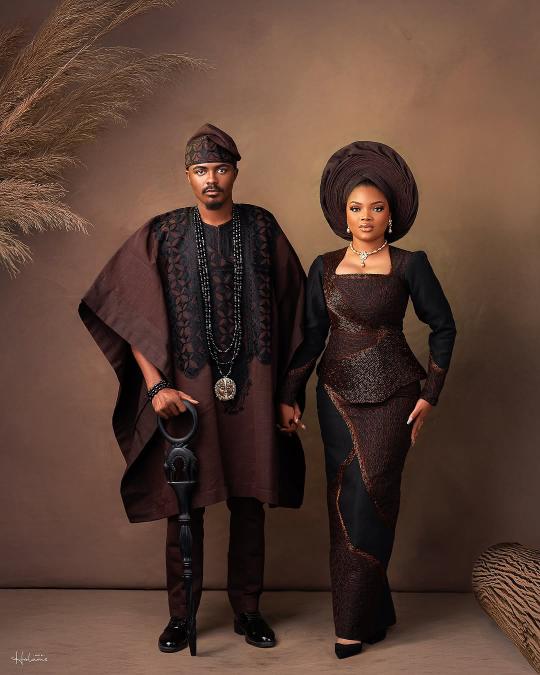
For Yoruba couples, for example, Aso Oke may feature prominently in the bride’s iro and buba, ipele or gele, and in the groom’s agbada or fila. Other Nigerian cultural traditions have their own distinctive garments, accessories and styling conventions.
These traditions provide a starting point, not a reason for every couple to look the same.
You might want a traditional look that feels regal and formal. Your partner may prefer a contemporary interpretation. Both preferences can be accommodated by agreeing on the shared elements first and allowing individual expression within that framework.
Comfort also matters. A beautiful outfit that is difficult to move in, too heavy for the planned activities or uncomfortable in the weather may affect how you enjoy the day.
Try this: Tell your designer what matters most to you culturally, how you want to look and how you need to move during the ceremony. The best design should respect all three.
7. Do the final coordination check before the wedding
Do not wait until the wedding morning to discover that the outfits compete with each other.
Once the main garments are ready, review them together. Include the gele, cap, jewellery, shoes and other accessories. If possible, take photographs of the complete looks side by side.
Ask yourselves:
- Is there a clear visual connection between the outfits?
- Is one outfit more elaborate than intended?
- Do the colours and textures complement one another?
- Can each person’s individual style still be seen?
- Are both outfits comfortable and appropriate for the ceremony?
If something feels off, you may not need to change the entire outfit. Adjusting an accessory, simplifying an embellishment or introducing a connecting colour may be enough.
The La Mode takeaway
The most memorable coordinated wedding looks are not necessarily the ones made from identical fabrics. They are the ones in which colour, texture, silhouette and detailing work together without erasing the personalities of the people wearing them.
Before you ask your designer to make both outfits match, decide what should connect them and what should remain individual.
Your wedding photographs will capture two people celebrating one occasion. Your outfits should reflect that connection while allowing each person to look and feel like themselves.
Planning your traditional wedding looks? Save this guide, share it with your partner and discuss these ideas with your designer before making your final fabric and styling decisions.


Comments are closed.