

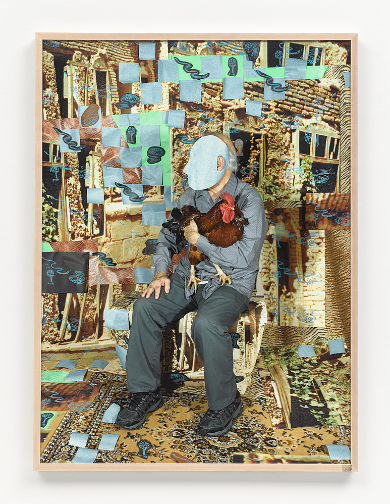
This is a portrait that feels difficult to read. The man in a grey suit sits down holding a rooster, the image surrounding him is not ordinary. He is placed against a background with photographs, patterns, architectural details and scattered fragments that seem to belong to different places. The arrangement of the painting feels almost like a collection of memories assembled without a clear definition, it leaves the viewer to figure out what connects them.
The man is dressed with his suit, tie and polished shoes suggesting a carefully prepared portrait. His seated position gives him a certain authority, the image doesn’t entirely allow him to settle into that role. His face is covered by a pale, featureless shape, making him difficult to identify or emotionally read. We can see how he is dressed and how he is positioned,the most recognisable part of a person’s identity which is the face is not revealed. It makes the portrait feel impersonal despite the attention given to his appearance.
There is the rooster, which is probably the last thing one would expect to find in a portrait like this. The bird is held close to the man’s chest, almost as if it is being protected or presented to the viewer. Its red feathers are particularly noticeable against the muted grey of his clothing. I find the pairing quite amusing at first, but the longer I look, the less I see it as a simple humorous detail. The bird seems too deliberately positioned to be an incidental object, and its presence gives the image an entirely different character.
The title itself gives the rooster a name, Manoocher, which is interesting because the man’s face remains hidden. The bird is identified, while the person holding it is visually obscured. That small decision changes the way I look at the portrait. The rooster is not just something included to make the image unusual; it becomes a subject in its own right. I almost find myself paying more attention to it than to the man, which feels like a deliberate reversal of what a portrait would normally ask of us.
Soleimani has filled almost every available space with something to look at. The background contains what appears to be a mixture of photographs, patterned surfaces, fragments of buildings, tiles and other imagery. Some parts look carefully placed, while others feel abruptly interrupted by a different image or colour. There is no obvious visual resting place. Even the floor beneath the man’s feet continues the collage, making the scene feel as though it extends beyond the wall behind him.
The arrangement reminds me of looking through several photographs at once, where one image begins to make sense before another interrupts it. The blue-green squares, patterned sections and architectural fragments do not seem to share one obvious setting. Instead, they create a space that feels assembled rather than photographed in a single location. The man sits within this constructed environment as though he belongs there, even though the surrounding imagery makes the setting difficult to recognise. It gives the portrait an almost theatrical quality, like a stage built from pieces of different places.
I also like the way the artist has avoided making the image visually tidy. The fragments do not come together into a perfectly seamless background, and the different patterns are allowed to compete with one another. There is a lot happening here, perhaps more than the viewer can take in at once. The portrait could easily have become overwhelming, but the grey suit gives the eye something solid to return to. The man’s clothing is relatively plain compared with everything around him, and that contrast helps keep him visible within the busy scene.
The work also raises questions about what we expect from a portrait. We are accustomed to portraits offering some form of access to the person being represented, whether through their expression, clothing, surroundings or posture. Soleimani provides some of these details but removes others. We can make assumptions about the man’s appearance and status based on his suit, but his covered face prevents us from forming a more direct connection. It feels as though we are being given clues without being allowed to arrive at a complete understanding of who he is.
Rather than feeling like a straightforward photograph of a man with his pet, the image seems to have been carefully constructed to make the familiar feel uncertain. The suit, the seated pose and the rooster could all be understood on their own, but together they create a portrait that is difficult to explain in one sentence. The work moves between something almost comical and something much more serious. It is not entirely clear whether we should be amused by the arrangement, question it or simply accept it as presented.
Khooroos (Rooster) Named Manoocher leaves me with more questions about the man than answers, which is probably what makes the portrait memorable. His face is hidden, his surroundings are assembled from fragments, and the rooster beside him has been given a name that makes it feel oddly important. I keep coming back to the bird, the blank face and the crowded background because none of them seem to offer a complete explanation for the image. The portrait gives us plenty to look at, but very little certainty about what we are looking at, and I think that tension is what holds the work together.


Comments are closed.