
South African artist Mary Sibande (b. 1982, Barberton), in Let Slip the Dogs of War (2015), articulates perhaps her most aggressive comment to date. This large-scale fibreglass and paint assemblage follows the tumultuous transformation of her alter ego, Sophie, from the ‘Purple Phase’ to the ‘Red Phase.’. Named after Mark Antony’s famous invocation to avenge his dead leader Caesar from Shakespeare’s Julius Caesar (“Cry ‘Havoc!’ and let slip the dogs of war”), it was developed as a sister artwork to Cry Havoc.
Initially it formed part of Sibande’s touring exhibition, The Purple Shall Govern. Here, a silicone and fibreglass mould of Sibande’s own body is dressed in a purple Victorian gown, the same puffed-sleeved design that Sibande has previously printed onto the uniforms of South African domestic workers. Attached to Sophie’s raised hand are leashes which are connected to a pack of growling blood red Staffordshire Bull Terriers. Significantly, the German Shepherd dog is not used – even though this is the usual canine favoured by the South African Police force – in favour of a more ‘urban’ and aggressive breed. Thus, the tool of government enforcement has been transformed into that of mass anger.
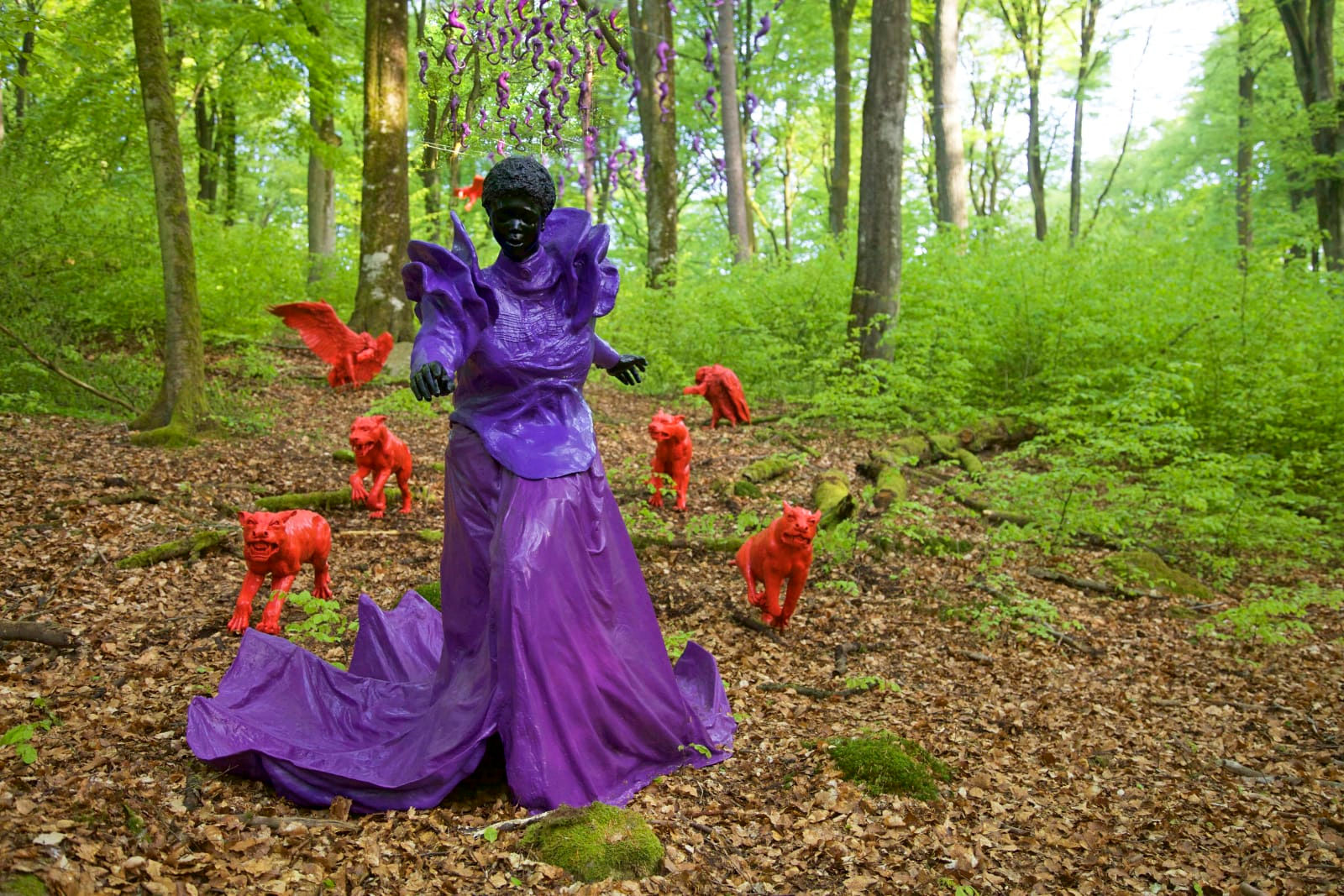
As well as being visually arresting, the red dogs are rich with meaning. They are inspired by an isiZulu expression, ie ukwatile uphenduke inja embovu, which translates as, “he is angry, he has turned into a red dog”. According to Sibande, this has been fundamental in informing her whole Red Phase. Like animals, humans can become enraged and in doing so lose their rationality and transform into an untamed, and often destructive, entity. By making Sophie the controller of the dogs, rather than a police officer, Sibande reverses traditional power relations. Contrary to her role historically as an oppressed domestic worker, she is now the one to unleash the dogs of war. Although Sophie continues to close her eyes, as is typical for her, (interpreted by the Frist Art Museum exhibition text as a symbol of resistance and of daydreaming), her body language is far from passive. Her raised, spread-fingered hand indicates authority, not entreaty. Unlike the Victorian maid, Sophie is a sort of vengeful, and morally upright, goddess.
Whilst the critical potency of Let Slip the Dogs of War is heightened by the interplay between its aesthetic and political aspects, the Victorian outfit is also highly symbolic. Woven from the identical cotton and tulle as the blue and white South African maid’s uniform, it is not worn ironically by Sophie but rather she seizes and wears her employer’s attire. As scholar Carol Brown has observed, Sibande’s approach “inverts the social power indexed by Victorian costume by reconfiguring it as a domestic worker’s uniform.” Furthermore, the colour purple evokes memories of the 1980s ‘Purple Rain’ movement. Throughout Apartheid, Black South African labourers, especially domestic workers, wore purple in order to assert their desire for respect and equitable pay. However, by the point that Sophie adopts the colour red within Let Slip the Dogs of War, there has been a further evolution in political stance; rebellion has superseded protest. Although the ‘rainbow nation’ period under Mandela is recognised, this has been identified as a false sense of security which concealed continuing racial and economic disparities.
Furthermore, the artwork can be analysed through the notion of hysterical representation. Much like the exaggerated posturing, flowery fabrics and raised arm of the Victorian female hysteric – a woman historically diagnosed by male doctors as suffering from hysteria – Sibande adopts and reworks this imagery. However, she removes the patronising undertones typically associated with it and re-creates the ‘hysterical’ female as an empowered and collective agent of anger. Moreover, the dogs and vultures, along with other challenging fauna which feature in Sibande’s wider Red Phase, do not represent the result of psychological dysfunction. Rather, they constitute an army for a nation that has been instructed to be thankful, but is no longer prepared to comply with this demand.
Whilst not a refined or reflective artwork, Let Slip the Dogs of War is dynamic, challenging and overtly political. Through it, Mary Sibande – who has been South Africa’s representative at the 54 th Venice Biennale (2010) and who won the Standard Bank Young Artist Award in 2013 – seeks to convey that, in post-Apartheid South Africa, true re-development can only occur following some form of deconstruction. The dogs need to be allowed to loose. Rather than debating the morality of this action, the artwork prompts reflection on whether such a move is already deserved.



Comments are closed.