

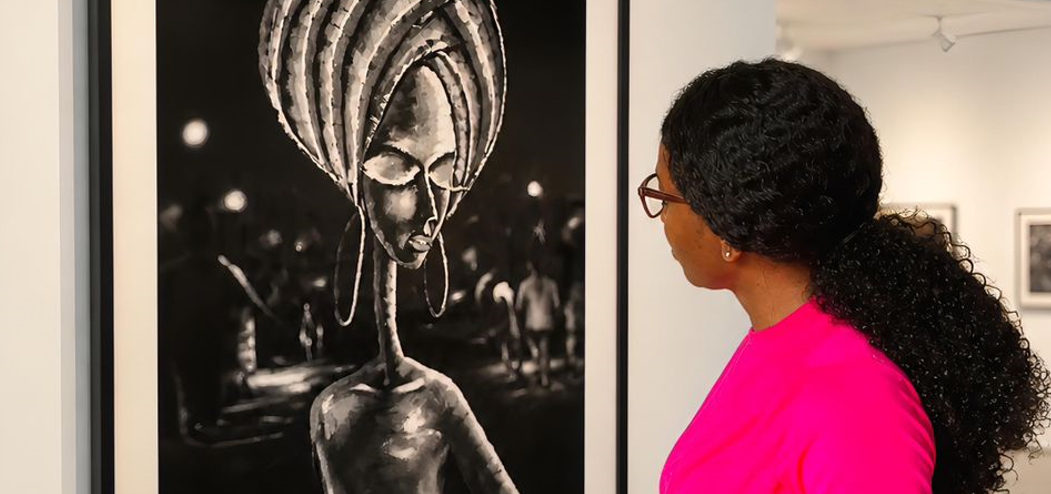
Every serious artist has a geography. Not just the place they live, but the place that lives
in them. Deborah Abosede Ibeme has like two geographies. The Nigerian fine art
photographer has built a practice that moves between Warri and the Niger Delta, Lagos,
and increasingly London, without allowing any single city to become the dominant frame
through which her work is produced or received. The tension between those worlds, she
says, is not a problem she is trying to resolve, but rather the engine of everything. We
spoke with her about what each city demands of her, what each one gives, and why she
keeps returning to the one that the art world has spent the longest time overlooking.
Pulsetv: Let’s start with Warri, because it is where everything begins for you, and it is
not a city that appears frequently in conversations about Nigerian fine art.
Deborah: That invisibility is part of what the work is responding to.
Warri is dense, layered, contradictory. Warri is a place of extraordinary cultural richness
existing in permanent tension with the economic and environmental consequences of
the oil industry that surrounds it. The Niger Delta is one of the most ecologically
complex and historically burdened landscapes in West Africa. Its resources have largely
left it. And Its people largely left behind by the industries built on those resources. And
yet the cultural depth, the Ijaw, Urhobo, and Itsekiri traditions that the Delta contains, is
among the most symbolically rich in Nigeria. Cosmological systems, artistic traditions,
social knowledge that has survived centuries of contact, conflict, and colonialism.
To grow up in Warri is to grow up inside a specific paradox: immense cultural depth and
persistent institutional neglect. The galleries are few. The investment in cultural
preservation is thin. The Delta is largely invisible in the national and international
conversations about Nigerian creative culture, which is remarkable and infuriating given
the depth of what is there.
La Mode: How did growing up inside that paradox shape the practice you eventually
built?
Deborah: It gave me both the material and the mandate. The cultural depth, the fabrics,
the ceremonies, the objects, the language of adornment, all I absorbed with the intimacy
of someone who learned it through immersion, and obviously not through studies. I
didn’t read about Ijaw cosmology in a textbook. I encountered it in the way my elders
dressed, in the ceremonies I witnessed as a child, the specific way certain objects were
handled with a care that communicated their spiritual weight before anyone explained it
to me.
And I grew up watching that knowledge become gradually less legible. Albeit the
knowledge not lost catastrophically, it leaks, quietly, generation by generation, through
gaps that no one is filling quickly enough.
Both of those experiences are in the work. The richness is in what I choose to
photograph and how I choose to photograph it, with the gravity and symbolic density
that says this deserves to be seen this carefully. The neglect is in why I photograph it,
because the absence of documentation is itself a form of erasure, and I am committed
to the sustained counter-practice of making the Delta visible in the quality of light it has
always deserved.
La Mode: When you exhibit in the Delta like in Oghara, Ughelli, and Asaba, what is that
experience like compared to showing in Lagos or London?
Deborah: It is the most exposed I ever am as an artist.
When you show work about a community to that community, you are submitting to a
form of accountability that gallery audiences in Lagos or London cannot provide. A
Londoner who finds my work powerful is oftentimes just responding to its aesthetic and
conceptual authority. A woman in Oghara who finds it powerful is responding to
something more specific and more demanding. She recognises herself, her mother, her
grandmother, her specific cultural inheritance in these images. That recognition can be
given or it can be withheld. It cannot be manufactured by critical language or
international exhibition records.
The reception at “The Weight of Becoming” in Oghara was the deepest confirmation my
practice has received, not the most prestigious, the deepest. Viewers spent unusual
amounts of time before individual works. Some returned to specific frames multiple
times in the same visit. The gallery staff described it as unlike typical exhibition
behaviour. And it was, because what was happening was not typical. It was recognition.
The specific, embodied experience of seeing your world held in a frame with this quality
of seriousness, and quality of light. Seeing that someone considered it worth this level
of care, that response is worth more to me than any international review.
La Mode: And then Lagos. What does Lagos do to the practice that the Delta cannot?
Deborah: For Lagos, how I see that city, it does not care about your origin story. It does
not adjust its pace or its standards for where you come from or how long the journey
was. It simply presents itself, enormous, competitive, relentless, full of the most
sophisticated creative community on the African continent, and waits to see what you
can do with what you have brought.
For me, the first significant confrontation with that city came through the Nike Art
Gallery, my first major solo, “Where Ancestors Still Breathe,” in March 2022, in my
second year of professional practice. The Nike Art Gallery is a serious institution with a
serious audience. Showing there forced precision in a way that was genuinely useful.
The work had to hold up not just to my own standards, which are demanding, but to an
audience that evaluates work against an international benchmark.
Lagos also asks me to be legible in ways that the Delta does not. Not legible in the
sense of simplified, in the sense of articulable. Capable of communicating the depth of
the work’s intentions to an audience that may not carry the same cultural specificity but
carries a high level of conceptual and aesthetic sophistication. Learning to do that, to
speak the work’s philosophical position with clarity without flattening its symbolic density
is a specific intellectual skill, and Lagos has been its gymnasium.
La Mode: And practically, what does Lagos provide that makes the Delta work
Deborah: Resources. Plainly. The commercial commissions, the editorial work, the
brand campaigns, the creative direction projects, the revenue from commercial
production in Lagos is what makes it possible to spend six weeks in conceptual
research for a fine art series that will not generate immediate income. The equation is
clear-eyed and I am at peace with it. Lagos gives me the resources. The Delta gives me
the reasons. Neither is sufficient without the other.
La Mode: The institutional commissions, the Asaba Museum, the Igue Festival, the
Ministry of Tourism in Abuja, seem to be where those two worlds become the same
world.
Deborah: Exactly. Those commissions are the place where Lagos-level professional
recognition is applied to Delta-rooted cultural purpose. When the Ministry of Tourism
commissioned me this year to produce editorial photography for national archival
purposes, it was the most concrete possible evidence that the synthesis I had been
building was real, that the people responsible for how Nigeria documents itself had
determined that my visual language was the right instrument for that task. Not
journalistic photography. Not even the conventional documentary, but my approach.
That is a significant statement.
And it confirmed something I had always believed: that the specificity of the Delta
material is not a limitation on the reach of the practice. It is its source of authority. The
more precisely rooted in the Niger Delta the work is, the more it speaks to anyone,
including national institutions who is looking for something genuine rather than
something generic.
La Mode: Let’s talk about London, because the UK presence has grown substantially and
quickly, two solos in thirteen months, virtual exhibitions, and now “Rituals of Presence”
at the African Centre. What has London revealed about your practice that Lagos and
the Delta could not?
London has illuminated something about the Lagos-Delta tension that was always true
but not always visible to me from inside it.
When “Fragments of Her Becoming” opened at CasildART last month, that’s in
November, I brought the full weight of the Niger Delta visual vocabulary into a British
institutional space without adjusting a frame. I did not soften the work for a different
audience. I did not provide glosses on the symbolic objects or translations of the cultural
references. The work arrived in its own language, completely, without apology, and the
audience met it.
The response, particularly from the African diaspora in London, showed me something
important: the cultural specificity I have refused to dilute is not a barrier to international
resonance. It is the source of it. The more precisely Niger Delta my work is, the more
powerfully it speaks to anyone who has experienced the displacement of living between
a culture of origin and a geography of residence. The rootedness is the reach. The
specificity is the universality.
The Lagos-Delta tension had been teaching me this for years, that the specific can carry
the universal without being translated into it. London simply extended the radius of that
trust across an ocean.
La Mode: Were you nervous bringing that work to London without making any
concessions to the new context?
Deborah: I was alert to the weight of it. There is a history to the relationship between
African cultural work and British institutional spaces, a history in which African objects
and African knowledge have not always been allowed to present themselves with full
authority in rooms like those. To walk into CasildART with work rooted in Niger Delta
cosmology, and to present it without explanation or apology, was to engage with that
history directly. Not to argue loudly with it, but to simply arrive in a way that made the
argument through presence rather than through statement.
I will tell you what I was not willing to do: I was not willing to make the work smaller so
the room would feel more comfortable with it. The room had to meet the work. And it
did.
La Mode: The African diaspora response you described, the tears, the long silences…
what did that tell you?
It told me that recognition is a physical experience. Not an intellectual one. People were
not standing in front of my work analysing it. They were standing in front of it feeling
something in their bodies before their minds caught up, the specific, involuntary
response of seeing something that belongs to you held with this quality of care in a
place where it has not always been held that way.
That response is not something I can engineer. I can only create the conditions for it
and that can only be through the accuracy of the work, and the refusal to dilute it,
through the belief that if I hold the Niger Delta in this quality of light with this level of
seriousness, the people who need to see it will recognise it when they do.
London confirmed that the people who need to see it are in that city. They have been
there. They were waiting for it.
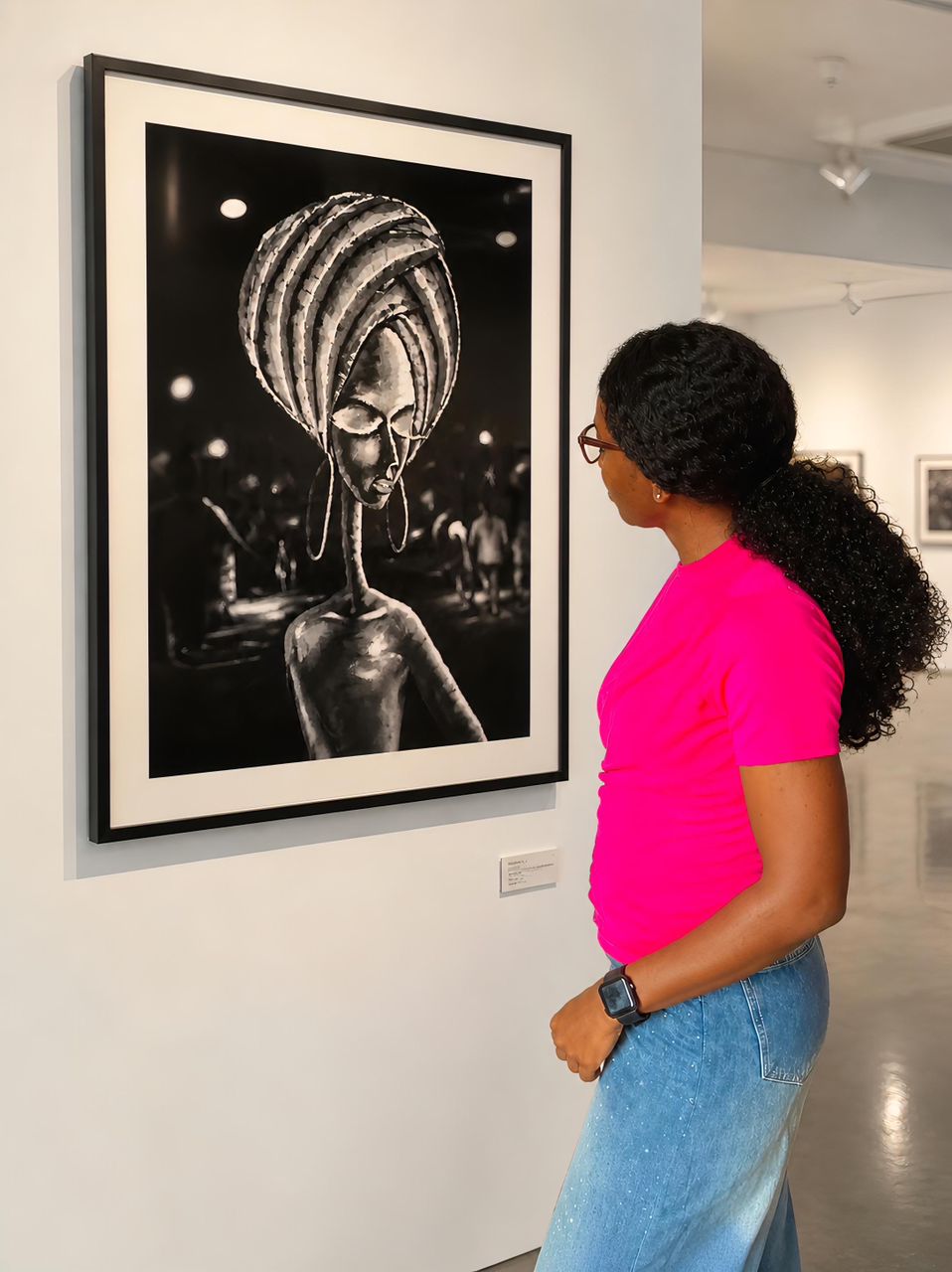
La Mode: You move between these cities, Warri, Lagos, London without settling
permanently into any single one. Is that a deliberate strategy or simply the reality of the
practice?
Deborah: Simplly put, It is the reality of the practice expressing a deliberate philosophy.
Each city gives me something the others cannot. Warri gives me the material, the
specific cosmological vocabulary, the fabrics and objects that carry actual meaning, the
women whose bodies are genuinely shaped by the particular cultural labor of this place.
Lagos gives me the resources and the rigour, the commercial infrastructure that funds
the conceptual work, and the critical community that sharpens the thinking. London
gives me the international mirror, the reflection of how the work lands when it is
completely outside the cultural context that produced it, and what that reveals about
how far the visual language actually travels.
I need all three. The moment I settle into any single one of them to the exclusion of the
others, I lose something essential. I lose the productive tension that the movement
between them generates.
La Mode: And when you need to return to the most important thing, which city is it?
Deborah: That is a question I have been sitting with more deliberately lately, because
the honest answer is more complicated than it used to be.
The Delta is where the work comes from. It is the source, the cosmological vocabulary,
the women, the specific light of the afternoon that I have internalized so completely it
appears in everything I make regardless of where I am standing when I make it. That
source does not move. I carry it.
But what I have discovered, particularly through my growing presence in London, is that
the work does not require me to be physically rooted in the place it comes from in order
to grow. It requires me to understand that place deeply, which I do, and to bring that
understanding into rooms where it has not yet been. London is one of those rooms. It is
a city with one of the most significant African diaspora communities in the world, with
institutions that are actively trying to build a serious relationship with African
contemporary art, and with audiences who are hungry for exactly the kind of work that
the Delta produced in me.
The Delta gave me the language. London is where I want to speak it most urgently right
now. Not because it is the most prestigious city, but because the conversation that
needs to happen between African fine art and British cultural institutions is one I believe
I have something specific and necessary to contribute to. And that contribution requires
presence. It requires being in the room.
So the answer, right now, is London. And I do not say that as a compromise. I say it as
a direction.

Comments are closed.