


There are two kinds of forgetting. The kind that happens when memory fails, and the
kind that happens when no one thought to remember in the first place. The second kind
is the more dangerous one. It does not feel like loss. It feels like the way things have always been.
Somewhere in Africa , and specifically in the Niger Delta, a woman ties her wrapper in a particular way. The non decorative knot she makes at her waist is a signature and a
declaration of marital status that communicates to anyone who knows how to read it
that something specific is true about who she is and where she comes from. Her
grandmother tied it the same way, even her grandmother’s grandmother before that.
The knowledge lives in the hands before it lives anywhere else, and if the hands stop,
and perhaps the generation that carries this specific literacy does not pass it forward, the knowledge becomes uncommon and ultimately invisible. And, what becomes
invisible long enough eventually becomes as if it never was.

This is the specific crisis that Deborah Abosede Ibeme has built a significant portion of her practice around addressing with the patient, sustained, technically rigorous
response of an artist who understood early that photography practiced at this level of
intentionality is a form of institutional memory, and not just the bare image-making. It serves as the construction of a record that the future can consult, and the present can also be held accountable by, that the past can rest inside without disappearing.
She calls it cultural archiving. The term is precise and worth sitting with. An archive is not a collection of beautiful things. An archive is a system of preservation, ordered,intentional, built with the understanding that its value compounds over time. What is archived today becomes irreplaceable tomorrow. What is not archived today is simply gone.
How an Archive Begins
The Cultural Preservation Series: the documentary-inspired body of work that began
formally in 2022 and continues to the present was not Deborah’s first engagement with
these themes. The themes preceded the series. In fact, they preceded, in some sense,
the photography itself.
Growing up in Warri, she absorbed the specific visual and symbolic vocabulary of the
Niger Delta. She encountered the Ijaw cosmology in everything within her environment;
the fabrics her elders wore, the ceremonies she witnessed, the particular way certain
objects were handled with a care that communicated their spiritual weight before
anyone explained it to her. She learned how meaning is carried in material culture, how
a community’s deepest knowledge does not live in its libraries or its official records but in its hands, bodies, domestic rituals, and its adornment.
She also grew up watching that knowledge become gradually less legible through the
erosion that modernity produces everywhere it arrives. For instance, young people who
no longer tie the knot that way, or ceremonies observed with decreasing specificity, or
even objects that migrate from contexts of meaning to contexts of decoration. Albeit the knowledge not being lost catastrophically, it leaks quietly, generation by generation, through gaps that no one is filling quickly enough.
The Cultural Preservation Series is her attempt to fill some of those gaps. And she
doesn’t intend a nostalgic return or indulgence, because she is not a nostalgic artist,
and her work carries none of the melancholy of someone mourning a past they wish
could be recovered. She actualises this with documentation, a precise, technically
excellent, visually authoritative act of saying: “this existed, this was real, this is what it looked like, this is what it meant, and it deserves to be held in this quality of light.”
The African Womanhood Series:
Running parallel to the Cultural Preservation Series, and in many ways, inseparable
from it is the African Womanhood Series, which began in 2021 and represents the most
sustained single thread of Deborah’s practice.
If the Cultural Preservation Series is primarily concerned with “what” is being lost, the African Womanhood Series is concerned with “who” is carrying it. These are apparently not two different subjects. With closer attention, one would find they are the same subject, only approached from different directions, always meeting at the body of the African woman.
In Deborah’s understanding of Niger Delta cultural life, the African woman is not simply a participant in cultural tradition but a primary custodian because, she is the one who ties the knot, the one who knows which fabric is appropriate for which ceremony, which object must not be touched by certain hands, which song is sung at which threshold of life. She is in fact the living archive.
Photographing her wouldn’t merely be to make a portrait, rather would be to photograph
the archive itself. In other words, this means that to turn the camera on the woman is to turn it on the knowledge she carries, and to do so with the visual gravity and technical precision that the knowledge deserves is to make an argument about its value.
An argument that says: this woman, and what she holds, is worth this quality of attention. This is the argument the African Womanhood Series has been making since 2021, frame by careful frame, and it has been making it with increasing sophistication and power with each new body of work.
“Where Ancestors Still Breathe”:
“Where Ancestors Still Breathe was her first public exhibition of this archival practice. The title is a theological statement disguised as a poetic one. In the cosmological traditions of the Niger Delta, traditions that are themselves part of what her archive is working to preserve, the ancestors are active presences and not just historical figures.
They are not behind us in time, but beside us in space, breathing through the decisions
we make, the bodies we inherit, the practices we maintain or abandon. The exhibition’s
title was meant to state a truth that the culture itself holds as literal: the ancestors are
here. They are breathing. The question is whether we are listening.
The works in this exhibition, produced with the full weight of her developing visual
language, the symbolic objects, the painterly light, the monumental subjects, were
received by a Lagos audience that includes some of Nigeria’s most sophisticated art
viewers. The response was not simply admiration for the technical quality, though that
was present and noted. The response was recognition. Viewers described encountering
images that made visible something they had been carrying without knowing they were
carrying it, a sense of ancestral presence, of cultural continuity, of belonging to
something older and larger than their individual lives.
This is what successful cultural archiving does when it is made into art rather than
simply into document. Rather than just preserve knowledge, it transmits it across time,
and across the boundary between the people who originally held it and the people who
need it now, in forms that the present moment can receive.
“Sacred Flesh, Silent Stories”:
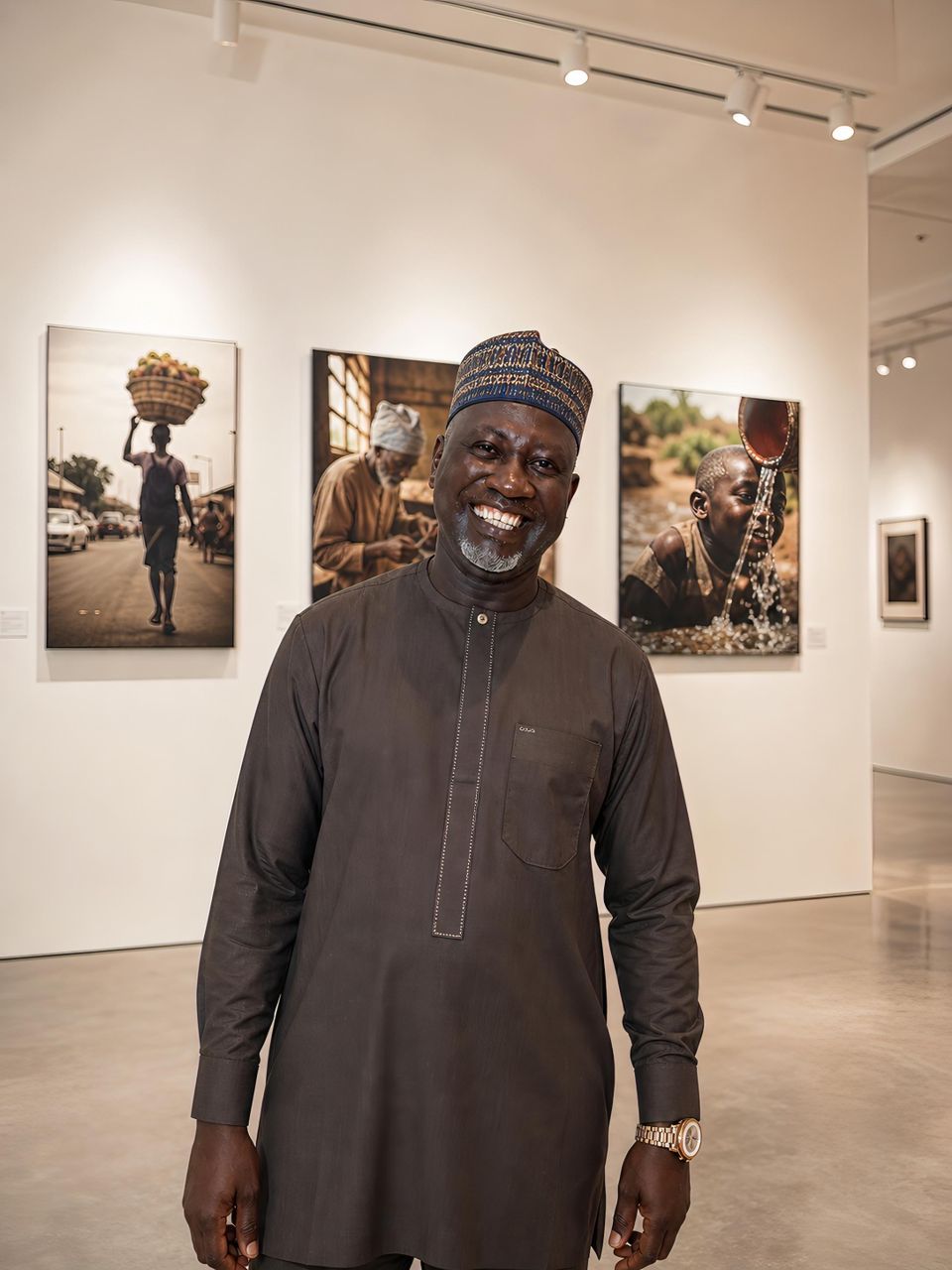
By the time “Sacred Flesh, Silent Stories” opened at TessArt Gallery in Asaba in May
2024, Deborah had refined the archival dimension of her practice to its most
philosophically precise formulation.
The title carries two distinct arguments. “Sacred Flesh” positions the physical body not
as matter but as consecrated space, a site of spiritual significance rather than merely
biological existence. “Silent Stories” on the other hand, names what that body contains:
narratives that are not spoken nor exist in written records, but live only in the specific
way that skin holds memory, that posture communicates inheritance, that the particular
gesture of a hand performing a ritual act encodes knowledge accumulated across
generations.
The works in this exhibition confronted, with unusual directness, the specific nature of
the archive that lives in the African woman’s body. The marks on skin, scarification
patterns that communicate lineage and spiritual allegiance. The posture of someone
who has carried physical weight in a particular way for decades, whose body has been
shaped by the labor of cultural maintenance. The hands that know, through repetition so
complete it has become reflex, exactly how to perform the acts that hold a community
together.
And that’s why, as earlier mentioned, Deborah was not merely photographing bodies but
photographing the evidence of knowledge including the way the body becomes, over a
lifetime of practice, a physical record of everything it has learned to do. She was making
that evidence visible, elevating it into fine art, and in doing so making the argument that
this kind of record deserves the same institutional respect and the same quality of
preservation as any written archive.
Asaba, as a location for this exhibition, was itself a statement. The city carries a specific
and heavy history; the Asaba Massacre of 1967 is one of the most significant and
underacknowledged atrocities of the Nigerian Civil War, a history still being reckoned
with. To bring an exhibition about the body as a site of memory and story to this specific
city was to engage, even implicitly, with the question of what bodies remember when
history does not record them. What the flesh holds when the official narrative fails.
“The Weight of Becoming”:
“The Weight of Becoming,” which opened at the Thought Pyramid Art Centre in Oghara
in February 2025, extended the archival project into its most psychologically complex
territory yet.
Oghara sits at the heart of the Delta, closer to the ground zero of the cultural practices
and the ecological world that Deborah’s archive is documenting than any of her previous
exhibition sites. To show this body of work in Oghara was to return the archive to its
source which in turn was to bring the documentation back to the people and the place
that the documentation is of, and to ask them to see themselves in the light she has
given them.
The exhibition examined the cost of becoming, specifically for African women navigating
the space between inherited tradition and contemporary life. It asked what is gained and
what is surrendered in that navigation. What cultural knowledge is preserved in the body
through transformation, and what is lost when transformation is complete. The “weight”
of the title is not merely metaphorical: it is the specific, physical, psychoemotional
weight of carrying two worlds simultaneously. Imagine it as of being a woman rooted in
the ancestral while moving through the contemporary.
Viewers in Oghara reportedly spent unusual amounts of time before individual works,
returning to frames they had already considered, standing in extended silences that the
gallery management described as unlike typical exhibition behavior. This is what
happens when an archive built in one’s own image is returned to its community of origin:
viewers view but also recognise and resonate. And recognition of this kind, the
recognition of seeing yourself and your people held in this quality of light, documented
with this level of seriousness, produces a response that goes beyond aesthetic
appreciation.
The International Dimension
The archival work does not stay in Nigeria. It travels, and in traveling, it performs an
additional function that the domestic exhibitions cannot.
When “Fragments of Her Becoming” opened at CasildART Gallery in London in
November 2024, it carried the full weight of the Niger Delta cultural archive into a British
institutional space. This is not incidental. Britain’s relationship with Nigerian cultural
heritage is historically complex, including the ongoing question of objects removed
during colonial administration that now sit in British museums without the consent of the
communities they came from. For a Nigerian artist to walk into a London gallery and
present Nigerian cultural knowledge on her own terms, in her own visual language,
without dilution or explanation, is to perform a kind of cultural repatriation that operates
through presence rather than through restitution.
Her work in London does not ask for permission to be significant. It arrives already
knowing what it is. And in doing so, in a room where African cultural knowledge has not
always been allowed to present itself with that kind of authority, it changes the room. It
asserts, simply by existing, that the archive of Niger Delta life and womanhood is not an
artifact to be held in a Western institution’s custody. Instead, it insists on itself as a
living, evolving body of knowledge actively being produced by a woman who comes
from the place it belongs to.
The international group exhibitions (New York, Nairobi, Ghana, Dubai) serve a similar
function at a different register. They place her archival work in conversation with
contemporary creative voices from across the African continent and diaspora,
demonstrating that the specific work of cultural documentation she is doing in the Niger
Delta is part of a broader, continental project of visual self-determination. African artists, across dozens of countries and dozens of languages and dozens of specific cultural contexts, are collectively building the archive that colonialism spent centuries trying to erase. Deborah Abosede Ibeme is one of its most rigorous contributors.
What an Archive Is For
An archive is not built for the present, but for the future and for the people who will not have lived the things being preserved, who will need a record to consult, who will want to know not just what happened but what it looked like, what it meant, what it felt like to be inside it.
Deborah Abosede Ibeme is focused on building her archive now, although in the
present, but with the full knowledge that its value compounds with time. Apparently, the photographs she is producing today will become irreplaceable with the passage of time. The culture will change, and the knowledge will shift. Even some of it will be lost, but what has been photographed will remain in private collections in Nigeria and the UK and North America, on gallery walls from Lagos to London, in the permanent record of a practice that understood, from its earliest days, that seeing is not enough.
That is the work she has given her practice to. Not the easiest work nor the most
commercially obvious work, but the necessary work. This is one that, when the
historians of African visual culture look back at this period, will constitute one of the most rigorous and most honest attempts to hold the Niger Delta in the light it always deserved. The ancestors, she has always said, are still breathing, she is making surethe record shows it.



Comments are closed.